Tuesday, 3 September 2013

Fun Topic: Hello Android Kit-Kat 4.4 (aka. Goodbye Key Lime Pie)

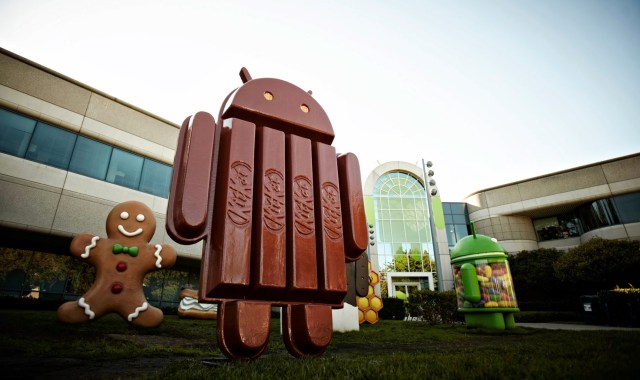
(Photo via TechCrunch)


Ok, so if you haven't heard already, Android 4.4 won't be called Key Lime Pie after all. Ironic because often Google isn't good at keeping it's name a secret and *everyone* I knew thought it was going to be Key Lime Pie. The photo via TechCrunch is Google lawn sculptures, which each represents a different Android version. It goes all the way back to original Android and first "dessert/junk-food" name in Cupcake (after that Donut, E-Clair, Froyo, Gingerbread, Honeycomb, Ice-cream Sandwich and Jellybean).You can read about it on the Android Blog here. (Yes, Android with "A", but there is no "B". Cupcake was the next real release...)

Until now, I only heard a really good story that ICS was in-fact "what do you get when you mix Gingerbread and Honeycomb?" However, KitKat "takes-the-cake" as it's an actual license deal with a trade-mark with Nestle. What is even tastier is that this statue actually represents real KitKat bars that Nestle will produce in the near future (50 million branded packs and a smaller number of actual Android KitKat bars according to the press release).
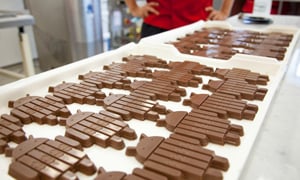

Nestle Press Release

Talk about very cool promotion! If you want to know more, Google & Nestle have created a site to promote the new Android 4.4 O/S here:


Another really cool idea is that no money changed hands during this promotion. It's basically a "like-for-like" deal, so basically win-win for both Google and Nestle. 
We’ve reached out to Google for more information on exactly what the deal is here and it confirmed that no money changed hands between the two companies. This is apparently a like-for-like cross-promotion deal.
Bartering is one of the oldest forms of payment and often the most economical. Not sure when the last time I saw two super-brands come together like this and no money changed hands. Is this the first of new "super-deals", which are much like comic-book cross-overs which two brands come together for short-run promo or gimmick? 

A year ago could this have been Android 4.3 Jello-O, and we've seen Bill Cosby sporting the latest Android device? Eventually could there be Android 10 Twinkie? 

Bottom line, I wonder if in the future O/S versions may be up for naming rights like football stadiums? Or at least up for some co-marketing, cross product campaign. Would Apple even name the new Mac O/S after another product line?

We live in interesting times.

Hope that helps...

Wayne Pau.

p.s. Talking about Twinkies, turns out someone has a 36 year old Twinkie. 


Maybe because it's out of it's wrapper, but it's not as it was portrayed on Wall-e. The article states that it had the texture of Styrofoam and Hostess representative "who strenuously suggested that nobody eat the thing". However the *most* disturbing things was apparently there was mold on it, and eventually even the mold died off. 
It would be a mistake to say this Twinkie looks none the worse for wear. It reportedly has the consistency of Styrofoam, not to mention having acquired a fine coating of dust during its decades on top of the intercom. It even grew mold at one point, despite all the preservatives, although that’s long dead now.
Not sure I'll ever look @ Twinkie the same ever again. 

Fun Topic: Microsoft buys Nokia (what's left for RIM?)

(via CNET article)

The news just came out that Microsoft is buying Nokia. Or pretty much all of Nokia. Basically the cellular business and patents, while absorbing 32K employees, about a 1/3 of the current ~100K workforce. This is interesting news as a few weeks ago I was talking about Samsung + Intel's investment in Tizen. It almost seems that to be successful today, you need both write the OS *and* build/sell the hardware, in Apple type of model. RIM and Apple are still the only vendors that exclusively write an OS for their own hardware.

So the articles say that board met over 50 times to discuss the purchase and that it had been in works since Feb 2013 @ MWC. Ironic, because I believe that Microsoft maybe then was trying to lower the cost of buying Nokia, since they marginalized Lumina users by not offering a Windows Phone 8 upgrade. John C Dvorak @ PCMag gave a pretty scathing article that finished with this quote:
"But it is not just as smart. Rolling out Windows Phone 8 and screwing over its only real partner proves that."

Google did purchase Motorola Mobility in August 2012, but said it's intentions weren't to dominate the cellphone market, but rather offer more features faster and cheaper and have more patents to defend itself. This was clearly a campaign to Android ODMs that Google was not abandoning them and that they should keep on pushing Android products. For he most part it has worked because by far the only real Motorola Android device I've seen of significance is the Motorola Xoom which was the first Android Tablet. For me, Android has been mostly a landscape of Samsung and HTC devices, but that may be changed as I discussed here.

Microsoft will likely have to also calm HTC, Samsung and other Windows Phone makers, but I am not sure they will be not so calming as Google. Ina Fried @ All Things Digital wrote this article on the topic.

Many knew something was coming. As I wrote before as reason #4 for creating Tizen, Samsung and HTC are already paying Microsoft for every Android phone they sell, which is big part of the $220 million Microsoft says it's makes in mobile. You can see in my Samsung makes Android, Windows Phone & Bada phones, Windows Phone from IDC only accounts for 2.6% of the 2012Q4 market. Sadly I believe very little of this was from direct Windows Phones licensing.

If Microsoft want to turn things around, they needed to do something, and that's what they did. They bought the biggest Windows Phone ODM and will put their marketing machine behind it. I heard many times that if Windows Phone had Nokia hardware engineering and Microsoft Marketing, it could succeed. We'll see how right (or wrong) they were.

As I said in my 'What happened to Surface RT' article, obvious something went wrong with Microsoft's last foray into mobile hardware. It will be interesting to see what happens now with Nokia. Seems like it's doubling down after Surface RT failed, so we'll see if it's "good money after bad" or it's what saved Microsoft post-Ballmer.

So bottom line, if anyone thought that Microsoft would buy Blackberry, I think they are having second thoughts, as they are about $7 billion poorer and 32K employees larger. With 1/3 more employees (and overhead) and having spent that much capital, Microsoft is really "betting the farm" on mobility. It will need to justify that investment quickly.

Microsoft must see the writing on the wall that you just can't *only* be tops in the desktop/laptop/server O/S and BackOffice/Tools markets. This ZDNet articles says it has some cash-cows, but it must see mobility is where it needs to be 'long term'.

Hope that helps...

Wayne Pau.

p.s. Just random thoughts, but if Samsung is teaming up with Intel with Tizen, Microsoft has purchased Nokia, has already been bought by Google and Apple is doing fine, I'm not sure there are suitors for Blackberry (as a whole). Maybe if an unlikely suitor like Oracle (or even IBM I guess) wants to get into the Mobile market? Dell seems have enough problems and HP/Compaq has had it's own share of issues. Maybe an Asian vendor like HTC, Huawei or ZTE will come up with the cash, as I was surprised when Lenovo purchased the personal computing business from IBM. The only other names out there are really Amazon and Facebook (who already has a pact with HTC, but it's reaper much reward from it...)? It will be interesting... I'll be paying close attention.

Here's Henry Blodgett @ Financial Post's take on the situation. Ironically #5 was bought by #6 on his list. 


Monday, 26 August 2013

Android UI Tips & Tricks: Developer Options (now hidden by default)

So it turns out that lately, Google is making the Developer Options harder to see (and thereby enable) by default:
On Android 4.2 and higher, the Developer options screen is hidden by default
In a way, I guess this is a good thing as the average user doesn't need this option. However for others of who developer on Android it came somewhat as a 'surprise' to say the least.

Here is the new 'official' response:


To access these settings, open the Developer options in the system Settings. On Android 4.2 and higher, the Developer options screen is hidden by default. To make it available, go to Settings > About phone and tap Build number seven times. Return to the previous screen to find Developer options.
(http://developer.android.com/tools/index.html)


It's fairly easy to do and once it's done it doesn't seem to revert itself unless you factory wipe the device. 

So for a 'run' down of some of things I do to a "brand-new" testing device right out-of-the-box, I usually (not necessarily in any 'particular' order):
  1. Turn on Developer Options (see above)
  2. Disable Sleep when plugged into USB
  3. Turn on Tap Tracking (great for solving those IxD problems)
  4. Go Security Settings and Allow Install Unknown 3rd Party Software (allows me to install builds form the build server prior to posting to Google Play Store)
  5. Enable USB debugging (for those pesky bugs where I need to real-time step through the code or at least the WebCat logs)
  6. Install any specific driver. (ie both Samsung and HTC both need special drivers to be able to debug attach to ADB/Eclipse, otherwise all you get is USB/MTP mounted mass storage device and it won't show up in the connected device list...)
You *only* need to enable Developer Options for 4.2+ Android devices. Previously it was displayed by default. 

Hope that helps...

Wayne Pau.


Thursday, 22 August 2013

Fun Topic: iPhone 5 "C" for Cheap (aka. a mini-priced iPhone)

(I apologize for the lack of posts in the last few weeks. I had my 2nd daughter at the end of July, a few weeks ago and as such, I haven't had a lot of time or sleep! However I wouldn't trade it for the world...)


(http://www.pcmag.com/article2/0,2817,2411709,00.asp)

Above is a sneak-peak at possible cases for the iPhone 5C that is planned to come out in September 2013. From what we can gather it's going to be a lower cost alternative to 5S also coming out at the same time. Ironic, since I had a posting last month talking about how ZTE and Huawei are making huge in-roads into HTC and Samsung largely through cheaper Android devices in Asia (which I believe ultimately where the 5C will make the most impact).

So... down to 'brass-tacks'. Sounds like full-on iPhone 5C will be about $350-$400. That is a reasonable discount when you compare that iPhone 5 is about $650. Ironically it's even cheaper than older iPhone 4S, which is in the $450 range.

Truthfully for the typical consumer this means basically 'free iPhone' with just about any 2 year plan. Now currently most carries *do* offer iPhone 4S $0 for 2 year plan, but only on more expensive data plans and because carriers are trying to liquidate older iPhone 4S stock.

Now you won't *need* iPhone 5X (basic, S or C) to run iOS 7. I believe you can still get it on iPhone 4/4S, so really the only reason to get one is because you don't have one. 

Therefore really, apple is using it's iPad Mini strategy and potentially cannibalizing it's current market share to attempt to squash lower priced competitors in one swoop. When we talk price, we should really talking margin and this PC Mag article that references IHS/iSuppli tells us exact the breakdown of iPad Mini costs. Bottom line is that Apple makes about $141 on an iPad Mini, while Google only squeezes out about $40. That's smart math, more than 3x the profit! That is the real motivation Apple developed or is still selling the iPad Mini. 

(Tim Cook is nothing if not predictable, as he seems to do the logical, safe bet things these days.)


*UPDATE* Here is another article from Gregg Keizer of ComputerWorld about the margins in the iPad Mini. Says the margin is closer to $90 on the lowest model. Still twice what some other 7" Tablets vendors are making.

So... with any luck we'll get another breakdown analysis showing that Apple is making more from the iPhone 5C than the other guys, ultimately selling more iPhones in total, and therefore more total revenue. Rumours are that the glass back is gone, cheaper plastic and parts are being used and that Siri and other 'premium' add-ons will be gutted. (I wonder if it would be like having iOS run on cheaper Android hardware? Or will it still have the Apple quality appeal?)

However it's done, if more people buy (in total) iPhones with this strategy, Apple wins.

You in the market finally for a iPhone 5C? Or maybe your teenage kids? Elderly parent? Annoying sibling or spouse that keeps taking your iPhone 5? Hit me up and let me know if you are planning on an iPhone 5C and what colour!

Hope that helps...

Wayne Pau.

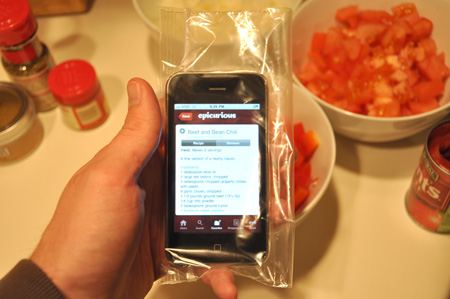
p.s. Just wait, if this colour thing works out, maybe they will steal another idea and release an iPhone 5X (aka Extreme) that will compete with the S4 Active. A iPhone that would be finally water proof and droppable! No more carrying your iPhone in a ziplock bag...


http://osxdaily.com/2010/02/08/waterproof-your-iphone/


Tuesday, 30 July 2013

Fun Topic: What happened to Surface RT? (Is this PlayBook OS all over again?)

$299 Surface Tablet @ Dell


Well if you haven't heard yet, the price of Windows RT tablets are dropping. About a month ago it happened first @ Dell, dropping their XPS 10 to $299. Really they weren't the first, just the most dramatic. 

Ironically, this all reminds of me PlayBook firesale or even the HP TouchPad firesale. When RIM (now Blackberry) did their firesale over a year ago everyone knew it was the end of the line for RIM Tablets. However there were people still clinging to their devices until Blackberry announced finally that BB10 OS would not be coming to Playbook. For this was final nail in the coffin for Playbooks. Blackberry will say it needed to do Playbook to learn to do BB10 properly. Now CEO Thorsten Heins saying that Tablets are dead:


“In five years, I don’t think there’ll be a reason to have a tablet anymore. Maybe a big screen in your workspace, but not a tablet as such.” - Thorsten Heins
(http://www.policymic.com/articles/39021/thorsten-heins-blackberry-ceo-tablets-will-die-in-5-years) 
I'm not entirely sure this isn't at some level sour-grapes as BB clearly failed and has abandoned the Tablet/Phablet market. Even Tim Cook and post Steve Jobs Apple finally gave in and built the iPad Mini. Also don't tell that to Amazon's Kindle department, which sales are on fire (vs. a fire sale).  

I love some of the tongue & cheek articles that joked that Star Trek invented tablets years ago. 4Oh5 clearly shows that even before Picard had on TNG, 2001: Space Odyssey had it too. I wonder if Heins is saying all those sci-fi movies were just plain wrong. Either way, after what Heins said, it's very very unlikely that Blackberry is ever going to make another Tablet anytime soon.

WebOS also went through a file-sale. Originally of Palm origins it was sold to HP. HP built a tablet, the TouchPad using WebOS and eventually had to liquiddate it's stock through a fire sale two years ago that ironically brought down eBay. HP was to offer the WebOS as open-source, but LG seems to have licensed WebOS for TVs, but not phones. 

If you read my post on Tizen, you'll notice that LG is not on the list of vendors, however likely is a company that is paying Microsoft the 'Android' patent. This is the response from CTO Dr. Skott Ahn as why LG didn't just go ahead and put Android in their TVs:


 Asked why it made more sense to invest in webOS than to repurpose Android, Ahn said that LG would use Android "together" with webOS, but that he thinks "webOS is better in some of the user experience, like card UI."
(http://gadgets.ndtv.com/laptops/news/hp-to-offer-webos-as-open-source-software-224848) 
Part of me is wondering if webOS license from HP was cheaper than the Android virtual license to Microsoft.

In the end HP, (unlike Blackberry) is returning back into the Tablet market again, two years after TouchPad fire sale. They are now aiming to sell the Slate, which runs Android even though they own WebOS. Unlike Thorsten, CEO Meg Whitman isn't making any claims that Tablets are passe.

So what's the bottom line? The fire sale could be the end-of-the-line for Surface RT. I'm not entirely sure I would shed a tear. I wasn't very fond of the 'legacy' windows interface that had icons so small I could only use with a touchpad in the keyboard. I thought the UX was a little 'too-flat' and didn't offer users any affordances on which were buttons, etc. I also agreed that there was utter confusion on which apps were running on Surface RT (formerly metro) and which couldn't.

I guess we'll have to wait to see. However I imagine we won't have to wait for long.

Hope that helps...

Wayne Pau.


Saturday, 20 July 2013

Fun Topic: Heard of Tizen? (Intel and Samsung give you $4 million reasons to care?)


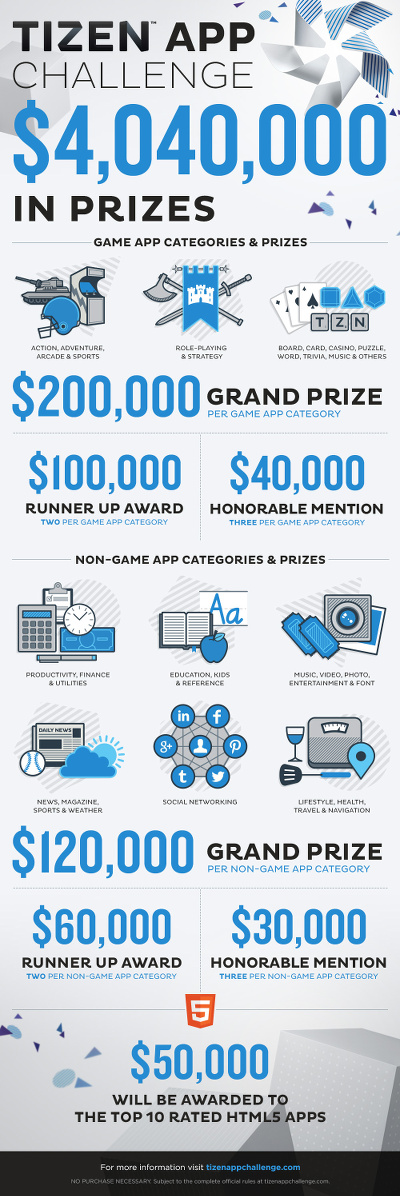
Wanna win $200,000? You can with a Tinzen app! Intel and Samsung are ponying up $4 million+ to make it happen.


As we saw in the previous post about Samsung's OS platform offerings, Tinzen phones are coming to Samsung in Q3 2013. If you've never heard of it, it's Open Source, Linux-based OS that supports SmartPhones, Tablets, TVs and Netbooks. It's the latest competitor to Android and Netbooks, etc. It's part of the Linux Foundation and both Samsung and Intel are main members (read: champions) of the steering group, which also include: 
  • Huawei
  • Intel
  • NEC CASIO
  • NTT DOCOMO
  • Orange
  • Panasonic
  • Samsung
  • SK Telecom
  • Sprint
  • Vodafone
  • KT
  • Fujitsu
.
At first I didn't understand why Samsung (and Intel) would do this, but after reflecting I came up with some 'guesses':

#1 - Intels needs more leverage (over Qualcomm)
The Qualcomm Snapdragon chipset is the hands-down winner for Mobile. If you are familiar with the Intel vs. ARM wars, almost every new Android device today runs ARM. HTC ONE and Samsung S4 run Snapdragon 600 and even Sony Experia ZL run S4 Pro chip. Intel has really has success with the Clover Trail Atom chipset in Android Tablets like Nexus 7 and Nexus 10, not really in phones.
(I think back when I was looking into this because I had ARM-only code in an Android app, I only really saw the ZTE Grand X2 and Orange San Deigo. Later I learned that Motorola Razr i also ran Intel Atom. Bottom line was that I wasn't too worried with only supporting ARM-only Android devices.)
 *IF* Intel can help make Tizen more popular than Android, it may have a better chance at a bigger share of mobile processor market. Current Intel is 12% compared to Qualcomm's 59% for Q1 2013. Intel wants to start to dominate this market because that where they believe the future growth is.
 #2 - Samsung wants ownership/control
At the end of the day, Google owns Android. That means Google will attempt to make friends with all vendors (ie. Nexus One - HTC, Nexus S/Galaxy/10 - Samsung, Nexus 4 - LG, Nexus 7 - Asus). Google owns the Google Play Store and isn't about to give that up (Samsung even went and built their own Samsung Apps). Samsung continues to 'tweak' Android with things like AES and KNOX without actually giving that back to Android community. 
Samsung already has Bada and Linux OS (aka SmartTV) that failed to dominate. If they can merge in Bada investment into Tizen, this seems like good avenue to able to have more influence and control over device OS.
 #3 - Samsung can re-use some Android & Bada Assets/Investments
Tizen can run both Bada and Android apps. Basically it's leveraging something similar to Android Player that BB10 had, but likely more up-to-date out of the box.
This means it's not starting from ground zero for Samsung and it can possibly leverage a large number of it's Java and internal Android assets. 

#4 - Samsung doesn't want to pay royalties (Microsoft)
You might think I'm crazy because Android is free (or most versions), right? Well it turns out that Microsoft is claiming $220 million just this quarter from 'mobile', but cleverly did not break that into Windows Phone vs. Android royalties. If you didn't know, Windows has agreements with everyone but Google Nexus/Motorola for patent royalties in exchange for not suing them. (Ironically the cost for this protection is more than the price for Windows 7 Phone itself. Likely a scheme to drive Windows Phone sales.)
(Note: Some quick math. If IDC says in Q4 2012, Android was 70% of the market, while Windows Phone was only 2.6%. It would be easy to see how you could carve out a good part of the $220 million in royalties quickly from 160 million units of Android phones being sold vs. 6 million Windows Phone sold, *if* assuming numbers in the last quarter were similar.)
So if Samsung and other vendors like Huawei can make an alternative, there may be a way they can get out of this round-about Microsoft royalty. I have no confirmation of this, it's just a theory or suspicion. 

Ultimately this looks like a no-lose situation. If Tizen works, Samsung and Intel are on the steering group and will likely reap many of the rewards. If not Samsung and Intel both have other avenues to still make money with.

Personally, what I think Tinzen lacks is a good eco-system. The hardest part of monetizing mobile apps is the 'app store'. Apple has a great iTunes AppStore and Google has done an admirable job with Google Play Store (formerly Android Market). 

Right now, there aren't a lot of options once you built your Tizen app to monetize it, however Tizen group claims a Tizen Store will be available sometime in 2013. Apple, Google and BlackBerry are all independent commercial entities. Not sure how Linux Working Group would run a App Store, but maybe that is where the Tizen Association comes in. I guess in a worst case scenario Samsung does have it's own App Store, but long term I don't think they are going to be *only* makers of Tizen devices. 

To contrast Tizen platform to another platform I know well, which is BB10 OS, Blackberry focused heavily on developers. They poured a lot of money into things like BlackBerry World and still claim that BB developers make more than iOS, Android and WinMo:


Did you know that BlackBerry World™ is the most profitable mobile application store for developers? According to Evans Data Corporation, 13% of vendors using BlackBerry World are making over $100,000 which is more than Apple®, Android™ and Windows Mobile.
(https://developer.blackberry.com/whyblackberry/)
They ran several BB10 developer conferences, gave away thousands of Dev Alpha A & Bs. Currently on the Dev Alpha Cs. They tried to make it easy to port apps (like Android APKs to BARs and HTML5 via WebWorks) and offered a range of development options. Ran Port-a-thons and lots of BBJAM conferences and even had an ingenious limited edition 12,000 'Red' Z10s reward program, much like KickStarter swag.

So a single contest I think is not enough. Backing from Intel and Samsung and good devices might not be enough. In my mind BB did all that and are still struggling. Time will tell what happens to BB and Tizen.

Hope you found that interesting.

Wayne Pau.

p.s. if you don't think Tizen is real, well you can already get a Cordova (aka PhoneGap) framework ported. Probably one of the quickest ways to get a Tizen app going. 

However if I *had* to build an app today I assume emulator may be the way to do. No Dev Alpha Tizens being given away that I've heard of. There have been a few YouTube vids of BETA devices, one of which you can see here:


http://www.youtube.com/watch?v=rJ1y7CpIaVA


(If you have found this post helpful, please consider either following this blog directly, following my twitter account @Wayne_Pau or request to add me on LinkedIn. If you've found this topic or another useful, I'd also greatly appreciate if you would be willing to spread the word on this blog by sharing it with your friends...Thanks!)


Monday, 15 July 2013

Fun Topic: Heard of Samsung Wave or Cronus phones? (aka Samsung != Android)


Did you think that Samsung only made Android devices? Turns out Samsung is planning to offer at least the following lines:

  • Galaxy - Very popular Android O/S series (includes S3, S4 and Note 2)
  • ATIV/Cronus - Windows Phone O/S series (Cronus not yet released)
  • Wave - Bada O/S series, Samsung's home-brew O/S
  • ??? - Tizen O/S series (aiming for Q3 2013) 

(Look for a future blog posting on Tizen OS coming soon!)

This is over and on-top of Linux distribution that is already currently in Samsung SmartTVs that also runs apps. I do think there are plans to migrate that over to Bada platform at some point in the future (and LG is already committed to using WebOS in their TVs), but you can see how this is quickly this approach is filling up the Samsung Developer portal:


(http://developer.samsung.com/home.do)

At some point you have to wonder how is Samsung going to even handle the roadmap and competition of resources for all these platforms. Logically I believe that Bada will eventually be rolled into Tizen and SmartTV linux platform phased out. Still, while Samsung appeared to be the champion for Android OS devices, it seems somewhere along the way they got diluted and likely that means they aren't 100% committed to the Google platform long term as everyone once thought.

Contrast this to Apple who has a single unified iOS platform with no fragmentation. They control both the direction of the OS and the production of hardware and therefore can optimize the development of both. The only other vendor with the same strategy is Blackberry (with BB10). 

Let's review the current IDC's current Mobile OS breakdown from Q42012:

By effectively offering multiple OSs, we can add Android's 70.1%, Windows Phone's 2.6% and Linux/Other 3% to give Samsung access to 75.7+% of the market. (I put "+" because both Android and Windows Phone had huge growth between 2011 to 2012, so we expect that trend to at least continue.) Besides BB10 and iOS, they are trying to 'cover all the bases'. Those are some staggering numbers that few other vendors can claim.

If you have the time, a very interesting read is an article by Chris Velazco of Tech Crunch here (however, be warned it's very very long):
How Samsung Got Big - http://techcrunch.com/2013/06/01/how-samsung-got-big/
Basically it tells of how Samsung came into power and shows how Samsung is really the GE of Asia. Tales of corruption and family politics reminds me a lot of Korean Drama 'Live in Paris'. A family run-empire in which chairman Lee Kun-Hee had to be pardoned by a Korean President twice to avoid jail time! The very same chairman that radically changed Samsung from a low-cost, poor quality alternative to industry leader did so with drastic moves, including being quoted as saying:
 "Change everything but your wife and kids..." - Lee Kun-Hee 
and having a bonfire the consumed $50 million of shoddy equipment in one day in 1995 in front of 2000 employees! (I don't even want to *think* of the environmental consequences of something like that...)

Ultimately Samsung's foray into High-end Mobile Handsets is a lot like how they overtook many Chinese and Japanese rivals. Turns out that doing business in Korea is not that different from anywhere Asia. 

Bottom Line: A part of me is still worried that the biggest, baddest champion for Android is really just a 'part-time' champion. So while Samsung is investing and making innovations that help shore-up Google's inherent limitations/weakness in things like security with AES and KNOX, ultimately it seems that Samsung doesn't view Android as "their" own OS (like Bada for instance). Given a couple of years, would Samsung be pushing Windows Phone or Tizen over Android if the market seemed to be swaying that direction? Letting HTC, Huawei, ZTE, LG and others fend for their own (excluding Motorola who is owned by Google)?

Comments? Thoughts? Concerns?

Hope that helps...

Wayne Pau.

p.s. if you're looking for more Korean Movies/Dramas, might I suggest My Sassy Girl and it's prequel Windstruck. It's one of my wife and I favorite movies. 


(If you have found this post helpful, please consider either following this blog directly, following my twitter account @Wayne_Pau or request to add me on LinkedIn. If you've found this topic or another useful, I'd also greatly appreciate if you would be willing to spread the word on this blog by sharing it with your friends...Thanks!)