It's not a new story, but when talking about Quantity vs. Quality there are definitely some misconceptions. However one parable often told about this is about a Ceramics Class. It's actually reproduced in the book Art & Fear, which I got from LifeClever blog entry:
The ceramics teacher announced on opening day that he was dividing the class into two groups. All those on the left side of the studio, he said, would be graded solely on the quantity of work they produced, all those on the right solely on its quality.
His procedure was simple: on the final day of class he would bring in his bathroom scales and weigh the work of the “quantity” group: fifty pound of pots rated an “A”, forty pounds a “B”, and so on. Those being graded on “quality”, however, needed to produce only one pot”albeit a perfect one”to get an “A”.
Well, came grading time and a curious fact emerged: the works of highest quality were all produced by the group being graded for quantity. It seems that while the “quantity” group was busily churning out piles of work ”and learning from their mistakes” the “quality” group had sat theorizing about perfection, and in the end had little more to show for their efforts than grandiose theories and a pile of dead clay.
I feel almost like Nissim Nicholas Taleb (author of The Black Swan) when I point out that there is often this fallacy that its much more efficient if we must focus on Quality and that it's mutually exclusive from focusing instead on Quantity.
In fact as counter-intuitive as it might sound, the opposite is actually true. I have seen the empirical evidence of this and this is why so many of today's ideologies (Agile, SCRUM, Design Thinking) all are set-up to constantly iterate, evolve and improve. (If you want proof of how this works look at the Intel example in Jim Collins' Great By Choice. Continued innovation is a staple of long-term success.)
Mathematically this should make sense, but this isn't the point I'm talking about. The "Infinite Monkey Theorem" states that a monkey given enough time at a typewriter could reproduce all the works of Shakespeare. However I'm not advocating randomly trying things and by shear volume making the next great product. I'm certainly not advocating getting more monkeys and more and typewriters! Design Thinking eliminates the need for this type of luck-based brutal force type of approach.
However, what I feel is understated today is the 'amount of quantity that' people should suspect a project needs before it's 'mature'. Bill Buxton in Sketching User Experiences suggests that good 'sketchers' may come up with 40+ sketches a day! A good Design Thinking project has multiple iterations, often starting with very quick, low-cost, low-fi prototypes and expanding to more elaborate, hi-fi prototypes when the team is more confident on what the users wants.
It's important to note that these prototypes go through iterations. Things changes, new ideas are introduced, but overall each successive prototype is built upon the previous version. Each one (generally - there are some lulls and backtracking...) becomes better than it's predecessor. So back to the Ceramics example, even more importantly if we were to line up all the pots by chronological order, we'd clearly see the progression of skill and mastery.
This is why Design Thinking is tightly coupled with building prototypes and more accurately sometimes called "Design Doing". Often times Design Thinking teams are crippled at a decision point and as Design Thinking Coaches we're encouraged to help them push through it by being decisive and often taking a risk. The reason for this is because we don't want teams stuck or bogged down by indecision. We'd rather a team make a choice, prototype it and the most importantly *test* it out on users. (At that point it often much quicker than just trying to guess what the user would like better...)
This is what I believe was equivalent to the "Quality" ceramics group was doing:
...the “quality” group had sat theorizing about perfection, and in the end had little more to show for their efforts than grandiose theories and a pile of dead clay
Show me a team that has a large graveyard of prototypes and sketches and I can almost guarantee they are being productive. What Design Thinking is not is simply a framework for brainstorm and evaluating ideas. It's an overall systematic approach of being in user insights that drive an iterative, feedback based approach to improve dramatically the odds of creating user-driven products.
Being of Asian decent, I can't resist the opportunity to use this famous quote:
"I hear and I forget. I see and I remember. I do and I understand."
- Confucius
Even 2500 years ago, we knew that doing was more important that just listening and observing. As sacrilegious as it sounds, I'd almost modify this to read:
"I hear and I forget. I see and I remember. I do and I understand...
...I then keep doing over and over and over again and I get BETTER."
- Confucius + Wayne
(If you've ever seen small Chinese children learn to write their first 5,000 Chinese characters, you'll understand what I mean!)
Still don't believe why quantity focus triumphs just quality focus? This is why rule #2 for Brainstorming from Stanford d.school is:
"#2 - Go for volume. Getting to 100 ideas is better than 10, no matter what you initially think about the “quality”. Try setting a goal for the number of ideas you’ll get to in a certain amount of time to provide some stoke."
So I guess my main question to you if you're doing design thinking is "How many ideas and prototypes have you been through lately?" Are you getting Quality via Quantity from your Design Thinking team?
One of the most famous quotes about volume is likely this one by Thomas Edison
"I didn't fail. I just found 2,000 ways not to make a lightbulb; I only needed to find one way to make it work." - Thomas Edison
However, I see the # of attempts anywhere between 2,000 to 10,00, but I think it's more likely 6,00-ish, according this quote from Franklin Institute:
"Before I got through," he recalled, "I tested no fewer than 6,000 vegetable growths, and ransacked the world for the most suitable filament material." - Thomas Edison
Reached your 50lbs yet? (.. be it 200x post-it ideas, 30x user interviews, 20x prototypes, 10x iterations, etc) Ensure you're setting a worthy Quantity goal constantly with your Design Thinking initiatives!
Hope that helps...
Wayne Pau
p.s. Just remember you still have to put in the time and that means actions. Just remember Malcolm Gladwell 10,000 hrs theory (also clearly stated in his Outliers book). Hitting the jackpot product in only a few iterations or prototypes is just getting lucky. If you want to take luck out of equation, you need to iterate and you need to keep going back to your users to get feedback and improve, evolve and re-factor.
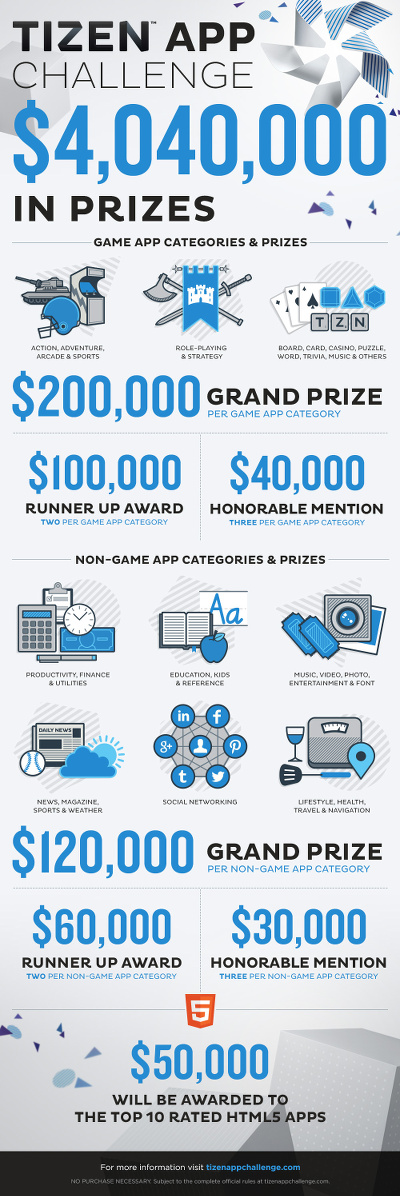
Wanna win $200,000? You can with a Tinzen app! Intel and Samsung are ponying up $4 million+ to make it happen.
As we saw in the previous post about Samsung's OS platform offerings, Tinzen phones are coming to Samsung in Q3 2013. If you've never heard of it, it's Open Source, Linux-based OS that supports SmartPhones, Tablets, TVs and Netbooks. It's the latest competitor to Android and Netbooks, etc. It's part of the Linux Foundation and both Samsung and Intel are main members (read: champions) of the steering group, which also include:
- Huawei
- Intel
- NEC CASIO
- NTT DOCOMO
- Orange
- Panasonic
- Samsung
- SK Telecom
- Sprint
- Vodafone
- KT
- Fujitsu
.
At first I didn't understand why Samsung (and Intel) would do this, but after reflecting I came up with some 'guesses':
#1 - Intels needs more leverage (over Qualcomm)
The Qualcomm Snapdragon chipset is the hands-down winner for Mobile. If you are familiar with the Intel vs. ARM wars, almost every new Android device today runs ARM. HTC ONE and Samsung S4 run Snapdragon 600 and even Sony Experia ZL run S4 Pro chip. Intel has really has success with the Clover Trail Atom chipset in Android Tablets like Nexus 7 and Nexus 10, not really in phones.
(I think back when I was looking into this because I had ARM-only code in an Android app, I only really saw the ZTE Grand X2 and Orange San Deigo. Later I learned that Motorola Razr i also ran Intel Atom. Bottom line was that I wasn't too worried with only supporting ARM-only Android devices.)
*IF* Intel can help make Tizen more popular than Android, it may have a better chance at a bigger share of mobile processor market. Current Intel is 12% compared to Qualcomm's 59% for Q1 2013. Intel wants to start to dominate this market because that where they believe the future growth is.
#2 - Samsung wants ownership/control
At the end of the day, Google owns Android. That means Google will attempt to make friends with all vendors (ie. Nexus One - HTC, Nexus S/Galaxy/10 - Samsung, Nexus 4 - LG, Nexus 7 - Asus). Google owns the Google Play Store and isn't about to give that up (Samsung even went and built their own Samsung Apps). Samsung continues to 'tweak' Android with things like AES and KNOX without actually giving that back to Android community.
Samsung already has Bada and Linux OS (aka SmartTV) that failed to dominate. If they can merge in Bada investment into Tizen, this seems like good avenue to able to have more influence and control over device OS.
#3 - Samsung can re-use some Android & Bada Assets/Investments
Tizen can run both Bada and Android apps. Basically it's leveraging something similar to Android Player that BB10 had, but likely more up-to-date out of the box.
This means it's not starting from ground zero for Samsung and it can possibly leverage a large number of it's Java and internal Android assets.
#4 - Samsung doesn't want to pay royalties (Microsoft)
You might think I'm crazy because Android is free (or most versions), right? Well it turns out that Microsoft is claiming $220 million just this quarter from 'mobile', but cleverly did not break that into Windows Phone vs. Android royalties. If you didn't know, Windows has agreements with everyone but Google Nexus/Motorola for patent royalties in exchange for not suing them. (Ironically the cost for this protection is more than the price for Windows 7 Phone itself. Likely a scheme to drive Windows Phone sales.)
(Note: Some quick math. If IDC says in Q4 2012, Android was 70% of the market, while Windows Phone was only 2.6%. It would be easy to see how you could carve out a good part of the $220 million in royalties quickly from 160 million units of Android phones being sold vs. 6 million Windows Phone sold, *if* assuming numbers in the last quarter were similar.)
So if Samsung and other vendors like Huawei can make an alternative, there may be a way they can get out of this round-about Microsoft royalty. I have no confirmation of this, it's just a theory or suspicion.
Ultimately this looks like a no-lose situation. If Tizen works, Samsung and Intel are on the steering group and will likely reap many of the rewards. If not Samsung and Intel both have other avenues to still make money with.
Personally, what I think Tinzen lacks is a good eco-system. The hardest part of monetizing mobile apps is the 'app store'. Apple has a great iTunes AppStore and Google has done an admirable job with Google Play Store (formerly Android Market).
Right now, there aren't a lot of options once you built your Tizen app to monetize it, however Tizen group claims a Tizen Store will be available sometime in 2013. Apple, Google and BlackBerry are all independent commercial entities. Not sure how Linux Working Group would run a App Store, but maybe that is where the Tizen Association comes in. I guess in a worst case scenario Samsung does have it's own App Store, but long term I don't think they are going to be *only* makers of Tizen devices.
To contrast Tizen platform to another platform I know well, which is BB10 OS, Blackberry focused heavily on developers. They poured a lot of money into things like BlackBerry World and still claim that BB developers make more than iOS, Android and WinMo:
Did you know that BlackBerry World™ is the most profitable mobile application store for developers? According to Evans Data Corporation, 13% of vendors using BlackBerry World are making over $100,000 which is more than Apple®, Android™ and Windows Mobile.
(https://developer.blackberry.com/whyblackberry/)
They ran several BB10 developer conferences, gave away thousands of Dev Alpha A & Bs. Currently on the Dev Alpha Cs. They tried to make it easy to port apps (like Android APKs to BARs and HTML5 via WebWorks) and offered a range of development options. Ran Port-a-thons and lots of BBJAM conferences and even had an ingenious limited edition 12,000 'Red' Z10s reward program, much like KickStarter swag.
So a single contest I think is not enough. Backing from Intel and Samsung and good devices might not be enough. In my mind BB did all that and are still struggling. Time will tell what happens to BB and Tizen.
Hope you found that interesting.
Wayne Pau.
p.s. if you don't think Tizen is real, well you can already get a Cordova (aka PhoneGap) framework ported. Probably one of the quickest ways to get a Tizen app going.
However if I *had* to build an app today I assume emulator may be the way to do. No Dev Alpha Tizens being given away that I've heard of. There have been a few YouTube vids of BETA devices, one of which you can see here:
http://www.youtube.com/watch?v=rJ1y7CpIaVA
(If you have found this post helpful, please consider either following this blog directly, following my twitter account @Wayne_Pau or request to add me on LinkedIn. If you've found this topic or another useful, I'd also greatly appreciate if you would be willing to spread the word on this blog by sharing it with your friends...Thanks!)