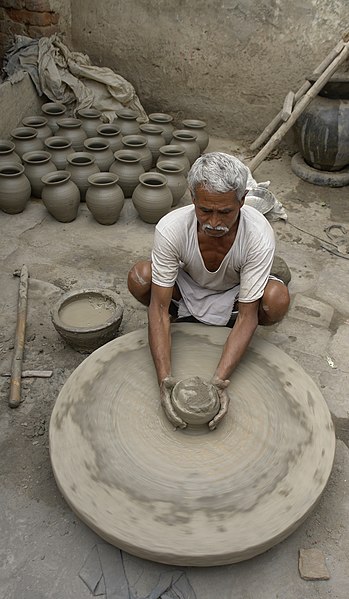
 |
| (From Wikipedia) |
It's not a new story, but when talking about Quantity vs. Quality there are definitely some misconceptions. However one parable often told about this is about a Ceramics Class. It's actually reproduced in the book Art & Fear, which I got from LifeClever blog entry:
The ceramics teacher announced on opening day that he was dividing the class into two groups. All those on the left side of the studio, he said, would be graded solely on the quantity of work they produced, all those on the right solely on its quality.
His procedure was simple: on the final day of class he would bring in his bathroom scales and weigh the work of the “quantity” group: fifty pound of pots rated an “A”, forty pounds a “B”, and so on. Those being graded on “quality”, however, needed to produce only one pot”albeit a perfect one”to get an “A”.
Well, came grading time and a curious fact emerged: the works of highest quality were all produced by the group being graded for quantity. It seems that while the “quantity” group was busily churning out piles of work ”and learning from their mistakes” the “quality” group had sat theorizing about perfection, and in the end had little more to show for their efforts than grandiose theories and a pile of dead clay.I feel almost like Nissim Nicholas Taleb (author of The Black Swan) when I point out that there is often this fallacy that its much more efficient if we must focus on Quality and that it's mutually exclusive from focusing instead on Quantity.
In fact as counter-intuitive as it might sound, the opposite is actually true. I have seen the empirical evidence of this and this is why so many of today's ideologies (Agile, SCRUM, Design Thinking) all are set-up to constantly iterate, evolve and improve. (If you want proof of how this works look at the Intel example in Jim Collins' Great By Choice. Continued innovation is a staple of long-term success.)
Mathematically this should make sense, but this isn't the point I'm talking about. The "Infinite Monkey Theorem" states that a monkey given enough time at a typewriter could reproduce all the works of Shakespeare. However I'm not advocating randomly trying things and by shear volume making the next great product. I'm certainly not advocating getting more monkeys and more and typewriters! Design Thinking eliminates the need for this type of luck-based brutal force type of approach.
However, what I feel is understated today is the 'amount of quantity that' people should suspect a project needs before it's 'mature'. Bill Buxton in Sketching User Experiences suggests that good 'sketchers' may come up with 40+ sketches a day! A good Design Thinking project has multiple iterations, often starting with very quick, low-cost, low-fi prototypes and expanding to more elaborate, hi-fi prototypes when the team is more confident on what the users wants.
It's important to note that these prototypes go through iterations. Things changes, new ideas are introduced, but overall each successive prototype is built upon the previous version. Each one (generally - there are some lulls and backtracking...) becomes better than it's predecessor. So back to the Ceramics example, even more importantly if we were to line up all the pots by chronological order, we'd clearly see the progression of skill and mastery.
This is why Design Thinking is tightly coupled with building prototypes and more accurately sometimes called "Design Doing". Often times Design Thinking teams are crippled at a decision point and as Design Thinking Coaches we're encouraged to help them push through it by being decisive and often taking a risk. The reason for this is because we don't want teams stuck or bogged down by indecision. We'd rather a team make a choice, prototype it and the most importantly *test* it out on users. (At that point it often much quicker than just trying to guess what the user would like better...)
This is what I believe was equivalent to the "Quality" ceramics group was doing:
...the “quality” group had sat theorizing about perfection, and in the end had little more to show for their efforts than grandiose theories and a pile of dead clayShow me a team that has a large graveyard of prototypes and sketches and I can almost guarantee they are being productive. What Design Thinking is not is simply a framework for brainstorm and evaluating ideas. It's an overall systematic approach of being in user insights that drive an iterative, feedback based approach to improve dramatically the odds of creating user-driven products.
Being of Asian decent, I can't resist the opportunity to use this famous quote:

"I hear and I forget. I see and I remember. I do and I understand."
- ConfuciusEven 2500 years ago, we knew that doing was more important that just listening and observing. As sacrilegious as it sounds, I'd almost modify this to read:
"I hear and I forget. I see and I remember. I do and I understand...
...I then keep doing over and over and over again and I get BETTER."
- Confucius + Wayne(If you've ever seen small Chinese children learn to write their first 5,000 Chinese characters, you'll understand what I mean!)
Still don't believe why quantity focus triumphs just quality focus? This is why rule #2 for Brainstorming from Stanford d.school is:
"#2 - Go for volume. Getting to 100 ideas is better than 10, no matter what you initially think about the “quality”. Try setting a goal for the number of ideas you’ll get to in a certain amount of time to provide some stoke."
So I guess my main question to you if you're doing design thinking is "How many ideas and prototypes have you been through lately?" Are you getting Quality via Quantity from your Design Thinking team?
One of the most famous quotes about volume is likely this one by Thomas Edison
"I didn't fail. I just found 2,000 ways not to make a lightbulb; I only needed to find one way to make it work." - Thomas EdisonHowever, I see the # of attempts anywhere between 2,000 to 10,00, but I think it's more likely 6,00-ish, according this quote from Franklin Institute:
"Before I got through," he recalled, "I tested no fewer than 6,000 vegetable growths, and ransacked the world for the most suitable filament material." - Thomas EdisonReached your 50lbs yet? (.. be it 200x post-it ideas, 30x user interviews, 20x prototypes, 10x iterations, etc) Ensure you're setting a worthy Quantity goal constantly with your Design Thinking initiatives!
Hope that helps...
Wayne Pau
p.s. Just remember you still have to put in the time and that means actions. Just remember Malcolm Gladwell 10,000 hrs theory (also clearly stated in his Outliers book). Hitting the jackpot product in only a few iterations or prototypes is just getting lucky. If you want to take luck out of equation, you need to iterate and you need to keep going back to your users to get feedback and improve, evolve and re-factor.

