Showing posts with label Phones. Show all posts

Monday, 24 March 2014

How Google *Pwned* Samsung & HTC (aka Why Nexus is still #1)


By now everyone has heard that Google has sold off Motorola Mobility and what a loss it was. I strongly disagreed with that and this Forbes article says a lot of what I felt. Google needed Motorola Mobility for its strategy to *pwn* other vendors who greedily thought they could exert their unique brand of is 'enhancement' further fragmenting Android is.

  • Google Nexus 5 #4, LG G2 #9
  • HTC One Google Ed. #2, HTC One #3
  • Samsung S4 Google Ed. #6, Samsung S4 #7
  • Moto X #5 (ahead of all ODM except HTC)
(As of Feb 2014 - Business Insider RANKED)

You can see this with the latest Android device rankings. Every Google Edition of nearly every ODM device is better that the original (HTC One and Samsung S4) and the Nexus 4/5 are way better that any LG offering, yet are also made by LG. Add to that the announcement that the new flagship Samsung S5 will be more Nexus/Google experience like, you can see that Google has exerted it's will over its android ODM (original device manufacturers). 

I had always wondered why Motorola devices weren't more innovative. Sure questions on 'fair play' concerns from Samsung, HTC, LG, etc was a factor but I don't think it was the main driver. I *think* Google was trying to make a point on the RIGHT way for ODMs to add value to androids with minimal OS changes and subtle hardware tweaks. All this allows for more equivalency/democracy amongst Android, (think number portability in North America years ago and carriers) making it easier for consumers to switch between makers within the android ecosystem. 

Moto X and G were like Nexus devices in disguise! This way Google could use LG as the nexus vendor for nexus 4 and 5 and basically get almost 4x Nexus phones (adding in the 2x Moto phones) in the last few years!

I was always curious as to why Google didn't try to build off the initial success of the Moto Xoom, the first Honeycomb 3.0 Android tablet. Both the Moto X and G are both Superphone format devics. If I had to guess the reason it would be either:

  • 'A' -  was happy with what it got from ASUS (why not? For the price the Nexus 7 is pretty much the best 7" tablet out there!)
  • 'B' -  thought that the larger market phone market (what Google calls "SuperPhones") fragmentation was more important to fix first.
Likely a little of both 'A' and 'B', but maybe more 'B' as money is still in "Superphones" and not really tablets. The margins are much higher still for cellular devices vs. WiFi-only. (See Cellphone Economics posting I had a while back.)

Don't believe me that ODMs don't want to make it easy to move to another Android phone manufacturer? See the photo below. Samumg and HTC intentionally make thier back button on different sides of the phone.


(S4 back button RIGHT from http://www.androidbeat.com/2013/05/review-samsung-galaxy-s4/)


(HTC ONE back button LEFT from http://androidandme.com/2013/10/news/t-mobile-htc-one-android-4-3-update-rollout-commences/)
Notice that the back buttons are intentional opposite. Compound that with two very different icons, one with a curved back arrow (Samsung S4) and another more like a square bracket (HTC ONE). Keen observers will also note that HTC ONE has no 'middle' button. Menus are all done by Context Action Bars (as suggested by Google Android Dev site a few years back). The Home Button on S4 is really the middle non-labelled button, yet again different from HTC and others.

I wish Google could have made this a 'Hardware' standard too. Not a problem with Apple's iPhone 5s vs. 5c! *Apple fan-boys cheer* Both because there is no back button (and no labels on iPhone5s) and that there is only 1x hardware manufacturer.


Hope that helps,
Wayne Pau

P. s. Nokia and Motorola used to do this too with pick-up and hang ups buttons which was worse! It totally annoys 1st time users who muscle memory jets them to go back a screen, only to have app close and go to the homescreen.

*** UPDATE *** Looks like Lenovo is also going the patent route, buying a number of patents from UP. Read more here. So you can clearly see that Google by keeping the patents from Motorola Mobility clearly knew what they were doing!

Tuesday, 21 January 2014

Fun Topic: Apple vs. Samsung (Fine Dining vs. Mega Buffet)

*Sorry for the gap in posts. Being in Toronto, Canada we've been through Ice-Storms, Polar Vortex and Power Outages! Hopefully we'll get this back on track again in 2014... thanks for your patience.*


There is no getting around that Samsung and Apple are two very different companies. They are headquartered in two different continents, have two very different corporate histories and basically seem to go about business in polar opposite ways. Apple does everything, including write the OS and design the perfect matching hardware. Samsung uses (non-exclusively) a 3rd party (Google) to write the core OS (Android) and focuses on adding on the basic OS with value-adds aligned with in-house designed hardware. Apple only supports iOS devices, yet Samsung makes more than just Android phones, hedging their bets with Windows Phone, Bada and Tizen phones. Apple is concerned with the end-product, where as Samsung also sells it components to other companies (even at one point to ironically Apple possibly for shortfall of retina displays for new iPad Mini Retina).

However today I want to look at one specific difference in basic philosophies between the companies. In Apple we have a 'brand-name' synonymous with design, and like a fine dinning establishment believe they know what consumers want and have no problems telling customers what that is. It's the "chic" resturant with only one or two daily specials. Where Samsung seems to be the more accommodating endless buffet whose goal is to have something that will please anyone.

If you look here, it lists no less than 23 models of phones that Samsung has released in 2013. For Samsung, it seems they would be embarrassed if you asked for a phone format combination that they didn't already produce. The older Galaxy Y Pro Dous was the smallest display at 2.6" and new Galaxy Mega 6.3 is currently the largest at 6.3" (phone-format device that is not a true phone, but tablet like Tab 7" and 10"), more than DOUBLE the size!
  • Samsung Galaxy S5
  • Samsung Galaxy Win Pro
  • Samsung Galaxy S Duos 2
  • Samsung Galaxy Express 2
  • Samsung Galaxy Round
  • Samsung Galaxy Ace 3
  • Samsung Galaxy Note 3
  • Samsung Galaxy S4 Mini
  • Samsung Galaxy S4 Active
  • Samsung Galaxy S4 Zoom
  • Samsung Galaxy Pocket Neo
  • Samsung Galaxy Star
  • Samsung Galaxy Core
  • Samsung Galaxy Y Plus
  • Samsung Galaxy Win
  • Samsung Galaxy Mega
  • Samsung Galaxy Fame
  • Samsung Galaxy S4
  • Samsung Galaxy Xcover 2
  • Samsung Galaxy Young
  • Samsung Galaxy Grand
  • Samsung Galaxy S II Plus
  • Samsung Galaxy Pocket Plus
(From http://en.wikipedia.org/wiki/Samsung_Galax)


(Samsung Galaxy Y Pro Duos - image from here)


(Samsung Galaxy Mega - image from here)


Apple on the other hand released 2x models in 2013, doubling the previous year's models with the 5s and 5c. Besides the *slight* pricing difference and visual colour offering, there really isn't that much difference between the available iPhones. Even Apple's own site points this out. The 5c has older A6 chip which isn't 64-bit, but many users would be hard-pressed to know the difference at this time between 64 vs. 32-bit iPhones (at this time... who knows about it in the near/short-term future... with apps and api in the feature that better take advantage of this... it may be more noticeable). Both phones use lighting connector, 720 video recording, 1080 HD display, 1136-by-640 resolution
and 326 ppi.
  • iPhone 5c
  • iPhone 5s


(iPhone 5s & iPhone 5c - images from here)

From a developer point of view, I find it hard to manage with the Samsung philosophy. There are so many disparate models with differing physical differences like screen sizes, resolutions, but also software & O/S level difference like Android O/S version and Premium Suite & security enhancement support like KNOX and SAFE. Having an app work perfectly on one Samsung Galaxy device does not ensure portability to another Samsung Galaxy device. Compound that with the issue that many models are region specific, it becomes a nightmare to support all but the most popular permutations.

From a consumer point of view, I find it hard to imagine how Samsung is able to make any "economy of scale" saving with so many different models of products. Shipping 3 or 4 models a year can be daunting for any company, but 23 models?!? For me I already get confused which are "budget" models or "premium" models. "S" and "Note" vs. the cheaper "Y" and "M" devices.

However it's hard to argue with Samsung's relative success. Compared to all other Android device manufacturers, they are the Apple of the Android world. For example, in 2 months, the new Galaxy Note sold 10 million units.

So bottom line? I hope I don't get into trouble for saying this, but it seems like Samsung is taking the safe-bet. It's spreading it's investment and ensuring that no device format is missed and basically offering the proverbial "Chinese Menu". So as a 'developer', I feel like the innovation is going to come from Apple and Samsung will always be playing catch-up. Realistically it seems like there are more Chinese Buffets than Michelin Star Restaurants.

Therefore, it might make sense for companies to develop for the less varied, but more refined iPhone and then attempt to move to support the massive offering from Samsung Galaxy/Android. Do you think Samsung took that into consideration when coming up with their product offering?

Hope that helps...

Wayne Pau

Monday, 9 September 2013

Fun Topic: Cellphone Economics Part 1 (aka. iPhone vs. iPod pricing)

The question I've been asking myself lately is:


"Are cellphone prices heavily inflated?"

So a few weeks ago I had a posting about the rumoured iPhone 5C release and I had a link to IHS/iSuppli breakdown of the iPad Mini. That got me thinking (which is never a good thing...) as I was peeking around at the pricing of the latest generation of iPod Touches and compared that to iPhone 5.

  • iPod 5 Touch 16 GB - $229
  • iPhone 5 16 GB - $669 (unlocked)
Pricing from Apple.com

 I was *shocked* (although I probably shouldn't have been) that you could get a iPod Touch 5, essentially get a iPhone 5 without the cellular part for less than HALF the price!

What is the *same*:


  • 4" retina display (1136x640 @ 326 PPI)
  • Almost identical bodies (iPhone is 7.6mm vs iPod 6.1mm)
  • FaceTime HD Camera (720p)
  • WiFi & BT connectivity
  • Apple EarPod headphones
What is *different*:
  • iPhone 5 has 8MP camera, iPod 5 has no camera (only 5MP on 32 + 64MB models)
  • Qualcomm Golbi MDM9615 4G LTE modem
I checked to see if IHS/iSuppli had a breakdown of the iPod 5 available for public consumption, but they did not. However I did find the iPhone 5, which I was at least a starting point to do some estimates on:

(From http://www.isuppli.com/Teardowns/News/Pages/iPhone5-Carries-$199-BOM-Virtual-Teardown-Reveals.aspx)

So... basically the total cost of iPhone is $199 in parts and $207 in BOM + Manufacturing in 2012. That's about 29.6% of $699 list price. Now if we subtract out the Golbi modem and camera, that's a simplistic subtraction of $52. That leaves $155, or 67.7% of the list price of $229. (Note: I image if I were cut everything we'd be closer to 50% mark... with lesser processor, etc)

That's *shocking*, that the margin on iPod is HALF of what it is on the iPhone.If we interpolated the same mark-up on iPod as the iPhone, we get $306, which is less than HALF again what the list price is. Now there may be more sub-par components in the iPod that I haven't caught cost-wise, but I can't image that you could get the BOM + Manufacturing costs below or around $100

(I'm actually more confident in that, after looking at the iPod Nano breakdown, which  IHS/iSuppli pegged at $43.73. This is with only 8MB and tiny display. There is $40 difference alone in LCD display and $6.45 in memory. That would put that almost at $90.20, and we aren't adding in more costs for bigger battery, WiFi and housing ,etc.)


What are looking at here then? I mean the iPod Touch is the closest thing to a cellphone without a cellular modem. Does this mean that Cellphone Companies and the ODMs are colluding together and inflating the prices of "smart-phones"?


This article from CNET had Luke Westaway discuss a very similar comparison with Asus. However I found the article somewhat unsatisfying considering I have the BOM breakdown in front of me from iPhone 5. Processor only accounts for less than 10% of the build cost.

Bottom line is that cellphones have a inherent "luxury" tax over non-cellular versions. This is probably driven by carriers who want very expensive phones that they can heavily subsidize with multi-year plans.  They want to sell you $700-$900 phones, it makes good business for them. 

Note (again): please understand that I am using information from IHS/iSuppli in my analyst which is by no means official pricing from Apple (as I doubt any exists). I have also made a lot of estimates and assumptions. This article was created for education or entertainment reasons *only*. 

Hope that helps...


Wayne Pau.


p.s. So what does that mean for someone frugal like me who might want a iOS device? (ie. for those Candy Crush Saga addicts...not me...personally, I'm OK with my current phone...) I'm wondering if you're better off with a $0 Android phone that you can share WiFi and buy a iPod 5 Touch. The main drawbacks are:

  • you won't have integrated calling and contact book 
  • you will have to carry 2x devices
  • you have to charge 2x devices

but you could be saving yourself like $400! Like you'd also save yourself some data charges as you're more likely to go free WiFi spots than tether to your Android Phone when given the chance @ Starbucks, etc.


I wonder what the carriers would do if everyone did this? Would that deflate or inflate usage charges as maybe more expensive handsets help off-set data, messanging and voice changes?

Saturday, 20 July 2013

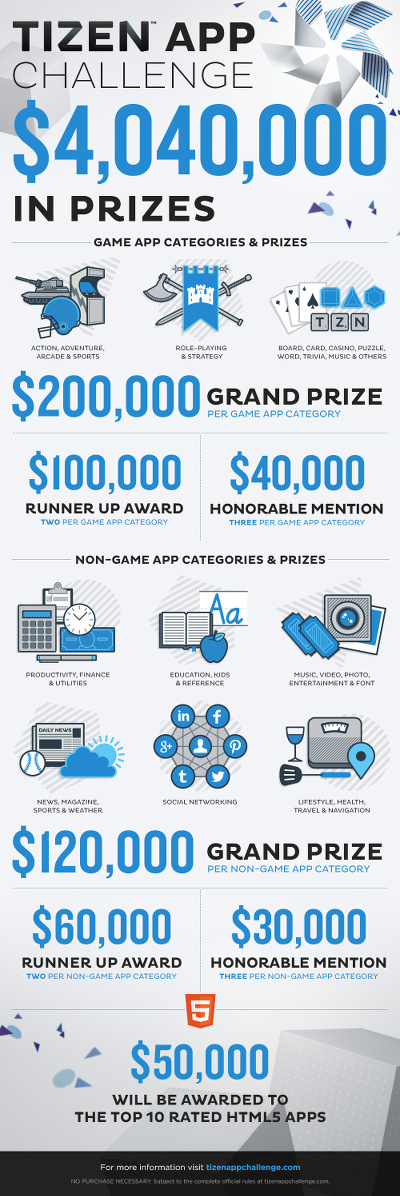
Fun Topic: Heard of Tizen? (Intel and Samsung give you $4 million reasons to care?)


Wanna win $200,000? You can with a Tinzen app! Intel and Samsung are ponying up $4 million+ to make it happen.


As we saw in the previous post about Samsung's OS platform offerings, Tinzen phones are coming to Samsung in Q3 2013. If you've never heard of it, it's Open Source, Linux-based OS that supports SmartPhones, Tablets, TVs and Netbooks. It's the latest competitor to Android and Netbooks, etc. It's part of the Linux Foundation and both Samsung and Intel are main members (read: champions) of the steering group, which also include: 
  • Huawei
  • Intel
  • NEC CASIO
  • NTT DOCOMO
  • Orange
  • Panasonic
  • Samsung
  • SK Telecom
  • Sprint
  • Vodafone
  • KT
  • Fujitsu
.
At first I didn't understand why Samsung (and Intel) would do this, but after reflecting I came up with some 'guesses':

#1 - Intels needs more leverage (over Qualcomm)
The Qualcomm Snapdragon chipset is the hands-down winner for Mobile. If you are familiar with the Intel vs. ARM wars, almost every new Android device today runs ARM. HTC ONE and Samsung S4 run Snapdragon 600 and even Sony Experia ZL run S4 Pro chip. Intel has really has success with the Clover Trail Atom chipset in Android Tablets like Nexus 7 and Nexus 10, not really in phones.
(I think back when I was looking into this because I had ARM-only code in an Android app, I only really saw the ZTE Grand X2 and Orange San Deigo. Later I learned that Motorola Razr i also ran Intel Atom. Bottom line was that I wasn't too worried with only supporting ARM-only Android devices.)
 *IF* Intel can help make Tizen more popular than Android, it may have a better chance at a bigger share of mobile processor market. Current Intel is 12% compared to Qualcomm's 59% for Q1 2013. Intel wants to start to dominate this market because that where they believe the future growth is.
 #2 - Samsung wants ownership/control
At the end of the day, Google owns Android. That means Google will attempt to make friends with all vendors (ie. Nexus One - HTC, Nexus S/Galaxy/10 - Samsung, Nexus 4 - LG, Nexus 7 - Asus). Google owns the Google Play Store and isn't about to give that up (Samsung even went and built their own Samsung Apps). Samsung continues to 'tweak' Android with things like AES and KNOX without actually giving that back to Android community. 
Samsung already has Bada and Linux OS (aka SmartTV) that failed to dominate. If they can merge in Bada investment into Tizen, this seems like good avenue to able to have more influence and control over device OS.
 #3 - Samsung can re-use some Android & Bada Assets/Investments
Tizen can run both Bada and Android apps. Basically it's leveraging something similar to Android Player that BB10 had, but likely more up-to-date out of the box.
This means it's not starting from ground zero for Samsung and it can possibly leverage a large number of it's Java and internal Android assets. 

#4 - Samsung doesn't want to pay royalties (Microsoft)
You might think I'm crazy because Android is free (or most versions), right? Well it turns out that Microsoft is claiming $220 million just this quarter from 'mobile', but cleverly did not break that into Windows Phone vs. Android royalties. If you didn't know, Windows has agreements with everyone but Google Nexus/Motorola for patent royalties in exchange for not suing them. (Ironically the cost for this protection is more than the price for Windows 7 Phone itself. Likely a scheme to drive Windows Phone sales.)
(Note: Some quick math. If IDC says in Q4 2012, Android was 70% of the market, while Windows Phone was only 2.6%. It would be easy to see how you could carve out a good part of the $220 million in royalties quickly from 160 million units of Android phones being sold vs. 6 million Windows Phone sold, *if* assuming numbers in the last quarter were similar.)
So if Samsung and other vendors like Huawei can make an alternative, there may be a way they can get out of this round-about Microsoft royalty. I have no confirmation of this, it's just a theory or suspicion

Ultimately this looks like a no-lose situation. If Tizen works, Samsung and Intel are on the steering group and will likely reap many of the rewards. If not Samsung and Intel both have other avenues to still make money with.

Personally, what I think Tinzen lacks is a good eco-system. The hardest part of monetizing mobile apps is the 'app store'. Apple has a great iTunes AppStore and Google has done an admirable job with Google Play Store (formerly Android Market). 

Right now, there aren't a lot of options once you built your Tizen app to monetize it, however Tizen group claims a Tizen Store will be available sometime in 2013. Apple, Google and BlackBerry are all independent commercial entities. Not sure how Linux Working Group would run a App Store, but maybe that is where the Tizen Association comes in. I guess in a worst case scenario Samsung does have it's own App Store, but long term I don't think they are going to be *only* makers of Tizen devices. 

To contrast Tizen platform to another platform I know well, which is BB10 OS, Blackberry focused heavily on developers. They poured a lot of money into things like BlackBerry World and still claim that BB developers make more than iOS, Android and WinMo:


Did you know that BlackBerry World™ is the most profitable mobile application store for developers? According to Evans Data Corporation, 13% of vendors using BlackBerry World are making over $100,000 which is more than Apple®, Android™ and Windows Mobile.
(https://developer.blackberry.com/whyblackberry/)
They ran several BB10 developer conferences, gave away thousands of Dev Alpha A & Bs. Currently on the Dev Alpha Cs. They tried to make it easy to port apps (like Android APKs to BARs and HTML5 via WebWorks) and offered a range of development options. Ran Port-a-thons and lots of BBJAM conferences and even had an ingenious limited edition 12,000 'Red' Z10s reward program, much like KickStarter swag.

So a single contest I think is not enough. Backing from Intel and Samsung and good devices might not be enough. In my mind BB did all that and are still struggling. Time will tell what happens to BB and Tizen.

Hope you found that interesting.

Wayne Pau.

p.s. if you don't think Tizen is real, well you can already get a Cordova (aka PhoneGap) framework ported. Probably one of the quickest ways to get a Tizen app going. 

However if I *had* to build an app today I assume emulator may be the way to do. No Dev Alpha Tizens being given away that I've heard of. There have been a few YouTube vids of BETA devices, one of which you can see here:


http://www.youtube.com/watch?v=rJ1y7CpIaVA


(If you have found this post helpful, please consider either following this blog directly, following my twitter account @Wayne_Pau or request to add me on LinkedIn. If you've found this topic or another useful, I'd also greatly appreciate if you would be willing to spread the word on this blog by sharing it with your friends...Thanks!)


Monday, 15 July 2013

Fun Topic: Heard of Samsung Wave or Cronus phones? (aka Samsung != Android)


Did you think that Samsung only made Android devices? Turns out Samsung is planning to offer at least the following lines:

  • Galaxy - Very popular Android O/S series (includes S3, S4 and Note 2)
  • ATIV/Cronus - Windows Phone O/S series (Cronus not yet released)
  • Wave - Bada O/S series, Samsung's home-brew O/S
  • ??? - Tizen O/S series (aiming for Q3 2013

(Look for a future blog posting on Tizen OS coming soon!)

This is over and on-top of Linux distribution that is already currently in Samsung SmartTVs that also runs apps. I do think there are plans to migrate that over to Bada platform at some point in the future (and LG is already committed to using WebOS in their TVs), but you can see how this is quickly this approach is filling up the Samsung Developer portal:


(http://developer.samsung.com/home.do)

At some point you have to wonder how is Samsung going to even handle the roadmap and competition of resources for all these platforms. Logically I believe that Bada will eventually be rolled into Tizen and SmartTV linux platform phased out. Still, while Samsung appeared to be the champion for Android OS devices, it seems somewhere along the way they got diluted and likely that means they aren't 100% committed to the Google platform long term as everyone once thought.

Contrast this to Apple who has a single unified iOS platform with no fragmentation. They control both the direction of the OS and the production of hardware and therefore can optimize the development of both. The only other vendor with the same strategy is Blackberry (with BB10). 

Let's review the current IDC's current Mobile OS breakdown from Q42012:

By effectively offering multiple OSs, we can add Android's 70.1%, Windows Phone's 2.6% and Linux/Other 3% to give Samsung access to 75.7+% of the market. (I put "+" because both Android and Windows Phone had huge growth between 2011 to 2012, so we expect that trend to at least continue.) Besides BB10 and iOS, they are trying to 'cover all the bases'. Those are some staggering numbers that few other vendors can claim.

If you have the time, a very interesting read is an article by Chris Velazco of Tech Crunch here (however, be warned it's very very long):
How Samsung Got Bighttp://techcrunch.com/2013/06/01/how-samsung-got-big/
Basically it tells of how Samsung came into power and shows how Samsung is really the GE of Asia. Tales of corruption and family politics reminds me a lot of Korean Drama 'Live in Paris'. A family run-empire in which chairman Lee Kun-Hee had to be pardoned by a Korean President twice to avoid jail time! The very same chairman that radically changed Samsung from a low-cost, poor quality alternative to industry leader did so with drastic moves, including being quoted as saying:
 "Change everything but your wife and kids..." - Lee Kun-Hee 
and having a bonfire the consumed $50 million of shoddy equipment in one day in 1995 in front of 2000 employees! (I don't even want to *think* of the environmental consequences of something like that...)

Ultimately Samsung's foray into High-end Mobile Handsets is a lot like how they overtook many Chinese and Japanese rivals. Turns out that doing business in Korea is not that different from anywhere Asia. 

Bottom Line: A part of me is still worried that the biggest, baddest champion for Android is really just a 'part-time' champion. So while Samsung is investing and making innovations that help shore-up Google's inherent limitations/weakness in things like security with AES and KNOX, ultimately it seems that Samsung doesn't view Android as "their" own OS (like Bada for instance). Given a couple of years, would Samsung be pushing Windows Phone or Tizen over Android if the market seemed to be swaying that direction? Letting HTC, Huawei, ZTE, LG and others fend for their own (excluding Motorola who is owned by Google)?

Comments? Thoughts? Concerns?

Hope that helps...

Wayne Pau.

p.s. if you're looking for more Korean Movies/Dramas, might I suggest My Sassy Girl and it's prequel Windstruck. It's one of my wife and I favorite movies. 


(If you have found this post helpful, please consider either following this blog directly, following my twitter account @Wayne_Pau or request to add me on LinkedIn. If you've found this topic or another useful, I'd also greatly appreciate if you would be willing to spread the word on this blog by sharing it with your friends...Thanks!)


Saturday, 15 June 2013

Pop Question: Do I need a different Phone *and* Tablet app? (Zebras vs. Horses)

I have to say, I get this (and a related) question quite often. It makes a lot of sense from a technical point of view, since 2x different apps means twice as much work, 2x different entries in Google Play Store/Apple iTunes/BB World, etc.


(Pair of Zebras @ Toronto Zoo)


Have you ever asked yourself what differentiates a  Zebra vs. Horse? They are both part of the Family "Equus" and some sources say the name the word "Zebra" comes from Portuguese meaning "Wild Horse" or "Wild Donkey". However, as much as a Zebra looks likes 'White' Horse with 'Black' stripes, turns out they are physiologically quite different. Zebras are said to be very hard to tame, have solid (aka "meaty") tails and ultimately Zebras are only native to Africa continent. For more info see here and here.

So for your apps, you need to take a look at how different it *would* or *could* run on Tablet vs. Phone. Can a single code-base run with enough detection/adaptation code to adjust properly on both formats? Would future enhancements or changes to one platform but not the other cause issues?

For example, look at my friends at NitroDesk, who offer a 'popular' (to the tune of 2 million users) very "security-focused" 3rd-party Email-App Vendor. Their Android offerings have both a Phone (aka "smartphone") and  Tablet (aka "HD") version.


TouchDown email for Android SuperPhones
 The Phone version is mostly optimized to the typical "Portrait" view with ListView control. In contrast the Tablet version is optmized to the typical "Landscape" view with multiple panel approach. It's not *just* the the size of the screen that is optimized, it's the user & interaction.

TouchDown email for Android Tablet

For us @ SAP, for the current mobile app I am working the answer was 'NO'. So the group I am working with has chosen to create separate a Tablet and Phone optimized with different IxD. (Note: The plan is actually for eventually 4x releases, iPad, iPhone, Android Superphone & Android Tablet.) 

Yes you can 'code' some of the logic into the app to auto-detect the screen size, density and layout, but especially for Android with the "Fragmentation" (not to be confused with a code android.app.fragment... I will have a posting on this topic soon...keep an eye out for it...), I don't believe this is going to be always 100% reliable. 

My current advice is to design and offer 2x different apps and guide the end-user to pick the optimal version. Ultimately I'd rather have 2x great apps posted vs. 1x mediocre one. 

Bottom Line: 

A Zebra is in fact not just a White Horse with Black stripes. 

Just like a Tablet is not just a bigger Phone, and therefore we shouldn't treat it as such.

Hope that helps...

Wayne Pau.

p.s. Yes, the opposite is also true. Can you "pigeon hole" users with 2x different apps? With both a Tablet and Phone optimized apps, what about Phablet users? My suggestion is to make Tablet and Phone optimized apps, but not restrict them via the app store (ie. Android Manifest file, etc). This way for users of a device that is a hybrid they can test out *both* apps and find which works best for them.


Thursday, 6 June 2013

UX Term of the Day: "Fitt's Law" (aka Fat Fingers...)


Ever have one of those controls on a screen that was Soooooooo small you couldn't tap it twice in a row if your life depended on it? These are the apps that make me pull out my pinky-finger in order to try to tap something... (If I'm totally honest with myself, pretty much every mobile phone soft-keyboard feels like this at times...there just *never* seems to be enough space to fit in all those keys!)

Earlier this year I was helping test an application for BB10 that clearly had some usability struggles. One of the issues that really stuck out was that one UI controls was about 4mm in width. That's actually about 1/2 what size it should have been.

So how big is big and how big is big enough? Turns it's not arbitrary and we have some math & science that basically tells how big something should be. The formula often used is called Fitts' Law:


Fitts' Law Formula

I've *simplified* here, but Difficulty (or technically the ID - Index of Difficulty) is logarithmically proportional to Distance Moved or how far the user has to move (the cursor or their "finger") and the Width of Button or the size of the 'tappable area' of the UI control. 

When we're talking about menu or nav buttons which could be selected from anywhere, really we don't care about distance moved (because it varies a lot), so really usability is somewhat *inversely* proportional to size. Even more so, if size *approaches* zero, the difficulty level becomes infinite! (Starting to remember infinity and limits from first year calc class, right?) 

In plain English, smaller buttons are harder and larger buttons are easier. Obvious right?

*However* the 'amount' that they are easier to use isn't linear, but rather at some point making the button bigger doesn't help *that* much. The converse is also true, at some point a little smaller can make it *really*really*reallyhard to use.

For the full math and derivation of Fitts' Law, I'd suggestion the following links. (These are mostly best left for "geeky" HCI PhD's...)


For the rest of us 'mere mortals', I would use Microsoft's (see below) much more human-understandable guidelines. I especially like MS depiction of various 'sizes' of fingers!

Quote from Microsoft (Win8) Touch Interaction Design Guide:


"People often blame themselves for having "fat fingers." But even baby fingers are wider than most touch targets. The image on the left shows the width of the average adult finger is about 11 millimeters (mm) wide, while a baby's is 8 mm, and some basketball players have fingers wider than 19 mm!"


http://msdn.microsoft.com/en-us/library/windows/apps/hh465415.aspx

MS goes on to say if you have a control @ 7mm, your error rate for mis-taps is about 1%. If you can make it at least 9mm, it's 0.5%. Notice how the curve is *almost* logarithmic? (Anything after 10-11mm, the difference is marginal at best. The % of missed taps gets smaller, but never 'actually' becomes zero...)

http://msdn.microsoft.com/en-us/library/windows/apps/hh465415.aspx

Apple too states that UI controls should be about 44 Pixels, which is about 9mm in real life on iPhones and iPads. Google/Android says 48 DPs, which is about 9mm on Superphones and Tablets, but the guidelines say stay within 7-10mm range if possible. 

(I think this is one of the *only* times I've ever seen all 3x big players agreed on anything!)

So bottom, if you don't want to do the messy math, 8-10mm should be a good threshold. Any smaller and you run a real risk of "mis-taps" from your mobile device (and likely *frustrated*) users.

Hope that helps...

w.

p.s. Still don't believe me? Every platform has a default "calculator" app. Load up the calculator app on your device and measure the physical size of the buttons. Break out the ruler and give it a try yourself!

Every time I've done this, at least one dimension is always at least 8mm long or longer. 


For the record here a quick snapshot of my finger on a ruler. I'd say that's just under 10mm and I assure you I don't have basketball player sized hands!

Wednesday, 5 June 2013

Pop Question: What's a Phablet? (Is the iPad Mini a Phablet?)

For a while now the 'industry' has been just inventing terminology for devices. The latest one is 'Phablet'.


Phone + Tablet = Phablet

Basically it's a device that is too big to be a phone and too small to be a true tablet. Here is "semi-official" breakdown of devices:

  • Phones - 5" or smaller display
  • Phablet - >5" and <7" display
  • Tablet - 7" or larger display


Phones today range up in size to largest phones like today's HTC One, Samsung Galaxy S4 or iPhone 5. On the smaller end they are like the cheaper "free" with contract Android phones or smaller HTC One SV or Samsung SIII (S3) Mini.  They are generally cellular devices, used regularly as phones and kept on the individual at all times.

Tablets today range up in size to 10"-ish devices like Samsung Galaxy Tab 10.1, Google Nexus 10 or iPad 3. On the smaller end they are like Samsung Galaxy Tab 2 (7"), Kindle Fire or iPad Mini. They are mostly used on WiFi or data-only devices, and often used in landscape (and not portrait) mode.

Phablets are the compromise between the two worlds. While other 5"-ish sized devices existed first, the forerunner for Phablets was the Dell Steak 5 (which died in 2011) which was unique in that it was bigger than a phone, but still could be used as a phone. 

However in my mind, the real 'King' of Phablets now is Samsung Galaxy Note and Note II (2). What makes it unique to me is not so much the size, but the EMR stylus which I mentioned in a previous post here.

Practically what does this mean? I don't really develop directly for Phablets. In reality I treat them as Phones, since the overall dimensions more resemble a Phone

For example, Samsung S4, a definitely Phone format is:
  • 5" Display
  • 16:9 Ratio
  • 1080 x 1920 Pixels
For example, Samsung Note II, a Phablet format is:
  • 5.5" Display
  • 16:9 Ratio
  • 720 x 1280 Pixels
Therefore the Note II is basically about 10% larger diagonally and lower number of pixels (but identical to the older SIII, which was 720 x 1280 pixels). The difference is **nominal**. (The Galaxy Tabs have 5:8 ratio which is much more "squat".)

Samsung Galaxy Tab 10.1 (left), Galaxy Note II (middle) and Galaxy S4 (right)
Have a look at the low-res snapshot above. Which one do you think the Note II more resembles? Tablet or Phone?

So practically... for me... from a mobile app development point of view, there is still just Phones and Tablets


Lastly, is the iPad Mini a Phablet? In my mind "no". It's well in the Tablet 7"+ space (7.9" to be exact) and it keeps the full-sized iPad ratio of 4:3. So for me, Phablets are pratically *only* an Android concept right now. 

For Apple, there are only iPads and iPhones. No iPhablets. Yet. j/k.


Hope that helps...

w.

p.s. For a great list of screen size, density and ratios, this Wikipedia page below is great. I use it all the time and it's fairly up-to-date and has almost all the most common devices:


The other list I usually use is off Blundell's blog, which is also updated very regularly.