Showing posts with label Android. Show all posts

Monday, 24 March 2014

How Google *Pwned* Samsung & HTC (aka Why Nexus is still #1)


By now everyone has heard that Google has sold off Motorola Mobility and what a loss it was. I strongly disagreed with that and this Forbes article says a lot of what I felt. Google needed Motorola Mobility for its strategy to *pwn* other vendors who greedily thought they could exert their unique brand of is 'enhancement' further fragmenting Android is.

  • Google Nexus 5 #4, LG G2 #9
  • HTC One Google Ed. #2, HTC One #3
  • Samsung S4 Google Ed. #6, Samsung S4 #7
  • Moto X #5 (ahead of all ODM except HTC)
(As of Feb 2014 - Business Insider RANKED)

You can see this with the latest Android device rankings. Every Google Edition of nearly every ODM device is better that the original (HTC One and Samsung S4) and the Nexus 4/5 are way better that any LG offering, yet are also made by LG. Add to that the announcement that the new flagship Samsung S5 will be more Nexus/Google experience like, you can see that Google has exerted it's will over its android ODM (original device manufacturers). 

I had always wondered why Motorola devices weren't more innovative. Sure questions on 'fair play' concerns from Samsung, HTC, LG, etc was a factor but I don't think it was the main driver. I *think* Google was trying to make a point on the RIGHT way for ODMs to add value to androids with minimal OS changes and subtle hardware tweaks. All this allows for more equivalency/democracy amongst Android, (think number portability in North America years ago and carriers) making it easier for consumers to switch between makers within the android ecosystem. 

Moto X and G were like Nexus devices in disguise! This way Google could use LG as the nexus vendor for nexus 4 and 5 and basically get almost 4x Nexus phones (adding in the 2x Moto phones) in the last few years!

I was always curious as to why Google didn't try to build off the initial success of the Moto Xoom, the first Honeycomb 3.0 Android tablet. Both the Moto X and G are both Superphone format devics. If I had to guess the reason it would be either:

  • 'A' -  was happy with what it got from ASUS (why not? For the price the Nexus 7 is pretty much the best 7" tablet out there!)
  • 'B' -  thought that the larger market phone market (what Google calls "SuperPhones") fragmentation was more important to fix first.
Likely a little of both 'A' and 'B', but maybe more 'B' as money is still in "Superphones" and not really tablets. The margins are much higher still for cellular devices vs. WiFi-only. (See Cellphone Economics posting I had a while back.)

Don't believe me that ODMs don't want to make it easy to move to another Android phone manufacturer? See the photo below. Samumg and HTC intentionally make thier back button on different sides of the phone.


(S4 back button RIGHT from http://www.androidbeat.com/2013/05/review-samsung-galaxy-s4/)


(HTC ONE back button LEFT from http://androidandme.com/2013/10/news/t-mobile-htc-one-android-4-3-update-rollout-commences/)
Notice that the back buttons are intentional opposite. Compound that with two very different icons, one with a curved back arrow (Samsung S4) and another more like a square bracket (HTC ONE). Keen observers will also note that HTC ONE has no 'middle' button. Menus are all done by Context Action Bars (as suggested by Google Android Dev site a few years back). The Home Button on S4 is really the middle non-labelled button, yet again different from HTC and others.

I wish Google could have made this a 'Hardware' standard too. Not a problem with Apple's iPhone 5s vs. 5c! *Apple fan-boys cheer* Both because there is no back button (and no labels on iPhone5s) and that there is only 1x hardware manufacturer.


Hope that helps,
Wayne Pau

P. s. Nokia and Motorola used to do this too with pick-up and hang ups buttons which was worse! It totally annoys 1st time users who muscle memory jets them to go back a screen, only to have app close and go to the homescreen.

*** UPDATE *** Looks like Lenovo is also going the patent route, buying a number of patents from UP. Read more here. So you can clearly see that Google by keeping the patents from Motorola Mobility clearly knew what they were doing!

Wednesday, 12 February 2014

UX: Don't Make Me Think Revisited (aka 3rd Edition)


When I came into the office in January I realized that Santa (aka Steve Krug) via Amazon had left me a belated X-mas gift via mail!


If you are in UX and haven't read this book (in any edition), I can't over emphasize how important this book is. Steve is great at making complex things seem "common sense" and his super reasonable, laid back, humourous approach can warm even the grumpiest usability Grinch.


The "revisited" (or "reloaded" for Matrix fans..) part also includes a whole new chapter on Mobility (Chapter 10, titled "Mobile: it's not just a city in Alabama anymore"). Really this chapter will take you 20 minutes to read but it could change your life, I mean app. It might be worth it to just to buy the book only to read this new chapter! It's 21 pages of very, very relevant material for anyone doing mobile development.

For something more "fun", have a look @ Steve's Blog on how he played with the covers before settling on the current design.


(http://someslightlyirregular.com/category/usability/)

=) Then... for even more fun do a quick search in Amazon of the book to see what other covers exists! It took me a bit to identify the 1st edition cover being so vastly different from 2nd edition, but I did find one in German with a neat look (Das intuitive Web!). So from 1st to 2nd edition, not much changed, but Steve and the published definitely made some whole-sale changes for 3rd edition. I personally think it looks great.


(Amazon Web Search URL)

With a gun pointed at my head, (ignoring that I consider Steve a friend) and told I could only get my team-mates and stakeholders to read just one book, this would be that book. It totally puts UX concepts into things the "everyday" person can understand. The examples (updated in 3rd edition) are incredible helpful and the humour makes it easy to get though the book in single day or sitting (although you might want to spread it out to let it sink it more or just constantly keep using as a reference).

Hope that helps...

Wayne Pau


p.s. In full disclosure, I admire Steve's knowledge and expertise in usability and even more importantly I really like him as a human being. He was generous enough to add me to acknowledgements page (yes I'm that Wayne Pau) but really my contributions and insights (if any) in the Mobility Section (Chapter 10) were very tiny. He's just that nice of guy! Thanks Steve...


Tuesday, 21 January 2014

Fun Topic: Apple vs. Samsung (Fine Dining vs. Mega Buffet)

*Sorry for the gap in posts. Being in Toronto, Canada we've been through Ice-Storms, Polar Vortex and Power Outages! Hopefully we'll get this back on track again in 2014... thanks for your patience.*


There is no getting around that Samsung and Apple are two very different companies. They are headquartered in two different continents, have two very different corporate histories and basically seem to go about business in polar opposite ways. Apple does everything, including write the OS and design the perfect matching hardware. Samsung uses (non-exclusively) a 3rd party (Google) to write the core OS (Android) and focuses on adding on the basic OS with value-adds aligned with in-house designed hardware. Apple only supports iOS devices, yet Samsung makes more than just Android phones, hedging their bets with Windows Phone, Bada and Tizen phones. Apple is concerned with the end-product, where as Samsung also sells it components to other companies (even at one point to ironically Apple possibly for shortfall of retina displays for new iPad Mini Retina).

However today I want to look at one specific difference in basic philosophies between the companies. In Apple we have a 'brand-name' synonymous with design, and like a fine dinning establishment believe they know what consumers want and have no problems telling customers what that is. It's the "chic" resturant with only one or two daily specials. Where Samsung seems to be the more accommodating endless buffet whose goal is to have something that will please anyone.

If you look here, it lists no less than 23 models of phones that Samsung has released in 2013. For Samsung, it seems they would be embarrassed if you asked for a phone format combination that they didn't already produce. The older Galaxy Y Pro Dous was the smallest display at 2.6" and new Galaxy Mega 6.3 is currently the largest at 6.3" (phone-format device that is not a true phone, but tablet like Tab 7" and 10"), more than DOUBLE the size!
  • Samsung Galaxy S5
  • Samsung Galaxy Win Pro
  • Samsung Galaxy S Duos 2
  • Samsung Galaxy Express 2
  • Samsung Galaxy Round
  • Samsung Galaxy Ace 3
  • Samsung Galaxy Note 3
  • Samsung Galaxy S4 Mini
  • Samsung Galaxy S4 Active
  • Samsung Galaxy S4 Zoom
  • Samsung Galaxy Pocket Neo
  • Samsung Galaxy Star
  • Samsung Galaxy Core
  • Samsung Galaxy Y Plus
  • Samsung Galaxy Win
  • Samsung Galaxy Mega
  • Samsung Galaxy Fame
  • Samsung Galaxy S4
  • Samsung Galaxy Xcover 2
  • Samsung Galaxy Young
  • Samsung Galaxy Grand
  • Samsung Galaxy S II Plus
  • Samsung Galaxy Pocket Plus
(From http://en.wikipedia.org/wiki/Samsung_Galax)


(Samsung Galaxy Y Pro Duos - image from here)


(Samsung Galaxy Mega - image from here)


Apple on the other hand released 2x models in 2013, doubling the previous year's models with the 5s and 5c. Besides the *slight* pricing difference and visual colour offering, there really isn't that much difference between the available iPhones. Even Apple's own site points this out. The 5c has older A6 chip which isn't 64-bit, but many users would be hard-pressed to know the difference at this time between 64 vs. 32-bit iPhones (at this time... who knows about it in the near/short-term future... with apps and api in the feature that better take advantage of this... it may be more noticeable). Both phones use lighting connector, 720 video recording, 1080 HD display, 1136-by-640 resolution
and 326 ppi.
  • iPhone 5c
  • iPhone 5s


(iPhone 5s & iPhone 5c - images from here)

From a developer point of view, I find it hard to manage with the Samsung philosophy. There are so many disparate models with differing physical differences like screen sizes, resolutions, but also software & O/S level difference like Android O/S version and Premium Suite & security enhancement support like KNOX and SAFE. Having an app work perfectly on one Samsung Galaxy device does not ensure portability to another Samsung Galaxy device. Compound that with the issue that many models are region specific, it becomes a nightmare to support all but the most popular permutations.

From a consumer point of view, I find it hard to imagine how Samsung is able to make any "economy of scale" saving with so many different models of products. Shipping 3 or 4 models a year can be daunting for any company, but 23 models?!? For me I already get confused which are "budget" models or "premium" models. "S" and "Note" vs. the cheaper "Y" and "M" devices.

However it's hard to argue with Samsung's relative success. Compared to all other Android device manufacturers, they are the Apple of the Android world. For example, in 2 months, the new Galaxy Note sold 10 million units.

So bottom line? I hope I don't get into trouble for saying this, but it seems like Samsung is taking the safe-bet. It's spreading it's investment and ensuring that no device format is missed and basically offering the proverbial "Chinese Menu". So as a 'developer', I feel like the innovation is going to come from Apple and Samsung will always be playing catch-up. Realistically it seems like there are more Chinese Buffets than Michelin Star Restaurants.

Therefore, it might make sense for companies to develop for the less varied, but more refined iPhone and then attempt to move to support the massive offering from Samsung Galaxy/Android. Do you think Samsung took that into consideration when coming up with their product offering?

Hope that helps...

Wayne Pau

Wednesday, 16 October 2013

Fun Topic: Cellphone Economics Part 3 (No Free phones...)

Sorry for lull in posting. It's been a busy few weeks...

(iPhone 5C from here)


Well I guess I was wrong about the iPhone 5c. Turns out the "c" didn't stand for cheap. At $450 it isn't really that much cheaper that it would be a zero dollar phone on 2 year a contract. (Update: confirmed. See here that it's $99 phone on 2 year from Verizon) I don't see that many new people who weren't already planning on buying a iPhone to go ahead and buy the iPhone 5c.

(Turns out the out-of-pocket difference is only $100 on 2 year contract between iPhone 5c and 5s. For my $ I would have likely upgraded to 5s.)

No "Free" Amazon Phone.

Also it seems that Amazon rumours of a FREE Android phone have been over exaggerated. From the looks of it, it will be "likely" an "at cost" phone, just the Kindle Fire, if it ever launches. If the Kindle Fire HD is around $215, how much would you pay for an Amazon phone? More or less than the 7" tablet? If you cut costs from smaller display and battery, will that offset the cellular modem costs?

My thoughts were the Kindle sold right against the Kobo and Sony reader. 7" is basically the size of a trade paperback and just smaller than a hardcover. Would you attempt to read a whole novel on your phone?
Part of me thinks that people already read *a lot* of email on your phone. Add on top of that, today on my commute I forgot my book, you *always* have your phone on you. This means your more likely to read more, even if it's in shorter bursts.

As a side note, great article on why the Kindle Paperwhite outsold the Sony Librie:

The other part of me feels that the main motivation of a cell phone is being a phone. If the Amazon phone isn't a better phone (or at least a very very good one), why would you sacrifice that to get books which you can already get via Kindle app? Building a WiFi 'tablet' I think is easier than true telephony features. Most phones today have a lot of software and hardware to make calls sound good.

Watch out for Xiaomi?

Yes, it's *that* company that lured a Google Exec away with a $58 million compensation package.
(New Xiaomi Mi3 from here)


From the reports (Xiaomi does *not* sell here in North America yet so I have never played with one) Xiaom Mi is the new 'king of cheap'. In Asian, this phone outsells the iPhone by a huge margin. I think the market in North America is huge for zero dollar phone on contract and maybe this is it.

You believe it? Here is an article showing just how fast these phones are selling:


From my Asian friends, they said they have heard nothing by positive things about it in the news & social media sits overseas.


Asus (Cheap) phones also coming soon?

With the success of Nexus 7 by ASUS, it seems they are ready to enter the phone market in North America. This is possibly via FonePad. Or maybe a totally new device. So far they have been locked out of the market, but with their engineering skills and co-innovation with Google, I see a very good chance of them being successful. If they can get out a Market-Leading 7" tablet for $250, how hard would it be for them to release a 4-5" good phone for under $300?

The bottom line is that I strongly feel like we need better cheap phones to continue driving cellular data and next wave of apps. The feature or dummy phones available today are getting long in the tooth. While they won't make a killing on margin per device, I see whoever can do this win on total sales and revenue. I think too many people are overdue for an update on a lower cost phone and the window of opportunity for major mobile device penetration in North America is now. (Implying the market for $700 and $800 upgrades of bleeding edge devices is drying up for now.)

Overseas where devices aren't usually subsidized as heavily, only the big spenders it seems can purchase devices outright at the high end of prices. Buying a new iPhone every year can add up quickly. Damage, loss or theft of a expensive new can be painful.

Lastly, not every wants or needs a Porsche. Companies like Hyundai are making a very good living selling reasonably priced cars.


So with that, are you, or someone you know looking for a new phone? Thoughts on what you might get?
Hope that helps...

Wayne Pau

p.s. While the talk now is about BYOD, there are stilll companies that give employees company standard issues phone. While a price difference one time of $50 to $100 might not seem like a lot, what if you multiply that out by 500x or more employees every few years? (FYI - that's $25K or $50K a year. Or $250K to $500K for 5000x person company.) I don't imagine that the more expensive product increases productivity that much (or if any at all).

Tuesday, 10 September 2013

Fun Topic: Cellphone Economics Part 2 (aka. WiFi iPad vs. 4G iPad)

So this is a follow-up to Part 1 in which I compared the iPhone 5 to iPod Touch, which was almost 1/2 the price. I got thinking and said, 'hey wait, the iPad comes in in WiFi and WiFi+4G versions', maybe we have a breakdown for that. Luckily, IHS/iSuppli has come through again:


(From http://www.isuppli.com/Teardowns/News/Pages/New-iPad-32-GB-4G-Carries-364-35-Bill-of-Materials.aspx)

So, when looking at the iPad 3, the main difference is the $41.50 modem. (I believe this is a Qualcomm Golbi, but it's not officially called out. For some reason it's about $3 more expensive than the one in the WiFi iPod Touch.) We also have a slightly more expensive Manufacturing cost, about $0.75, most likely from the need to mount and solder on the chip, maybe antenna, etc. The total difference is $42.25.

The simply math is that $42.25 allows Apple to charge $130 more. That's basically 3x or 308% markup. Compare that to the roughly $52 (Camera + 4G modem) that allows Apple to charge $420, that 8x or 807% mark-up when going from iPod Touch 5 to iPhone 5!. (This is one is "approximate" because I have costed it out totally electro-mechanical differences + labour cost, etc., unlike in the iPad 3). 

Clearly, there is a huge mark-up for making an iPod Touch 5 (entertainment device) into a iPhone 5 (cell phone). 

If you think this is the only place where Apple really gauges people, it's not. Another very obvious area is extra memory aka. NAND flash memory. (BTW, note that Apple isn't the only one to do this.)  For iPad 3 WiFi+4G, going from 16GB to 32GB, it's an additional $16.80, but an overall consume cost of $100, or basically 6x or 595% mark-up. Going from 16GB to 64GB it's an additional $50.40, but an overall consume cost of $200, or basically 4x or 397% mark-up. (Note to self, if you're splurging, it's a better deal to go for the larger 64GB. You're paying less mark-up!)

I *think* this is a BIG reason why all iOS devices don't offer external storage via MicroSD slot is because it makes good business sense *not to*. The going rate today I think is about $50 for 64GB MicroSD. So on any Android with MicroSD slot you are only paying like 25% of the price (or $50 instead of $200) to get at least 64GB of (extra) memory (that you can re-use potentially later down the road). 

Andrew Rassweiler of IHS pretty much sums it up here:
“The NAND flash memory is one of the key profit-generating components for Apple in the new iPad line, as it has been in previous iPads and in the iPhone family,” Rassweiler noted. “Apple makes far and away more money in selling consumers NAND flash than NAND flash manufacturers make selling it to Apple. And the more flash in the iPad, the higher the profit margin there is for Apple.”
(http://www.isuppli.com/Teardowns/News/Pages/New-iPad-32-GB-4G-Carries-364-35-Bill-of-Materials.aspx)
So while there may be concerns with security of having external storage, etc, Apple is definitely taking full advantage of the situation.

Hope that helps...

Wayne Pau.

p.s. So what *if* Apple did offer external storage like Android does? 

Once again with Android  (And from this post, it seems *a lot* actually do) , if it supports SDXC, you could actually get even more memory than just 64MB. The specs say that SXDC can actually hold up to 2TB! Imagine a 2TB iPhone? No need for iPod Classic anymore...

However SD card storage comes at a cost. It's harder to manage from a software point of view and it's a potential security threat or attach point. Yet a big part of the real motivation for for Apple is 'possibly' economics.

For the record, HTC One line (everywhere but Asian) doesn't offer SD Card storage either. So it's not just Apple. 

Tuesday, 3 September 2013

Fun Topic: Hello Android Kit-Kat 4.4 (aka. Goodbye Key Lime Pie)

(Photo via TechCrunch)


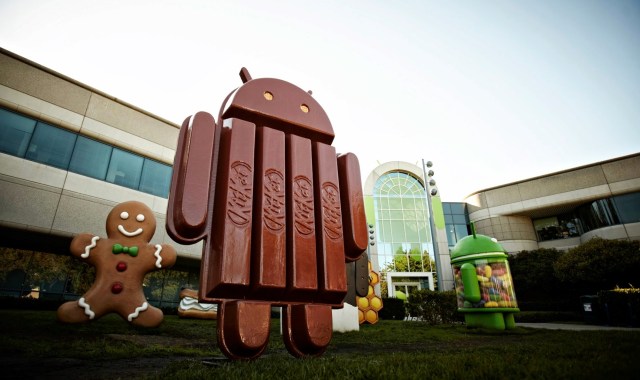
Ok, so if you haven't heard already, Android 4.4 won't be called Key Lime Pie after all. Ironic because often Google isn't good at keeping it's name a secret and *everyone* I knew thought it was going to be Key Lime Pie. The photo via TechCrunch is Google lawn sculptures, which each represents a different Android version. It goes all the way back to original Android and first "dessert/junk-food" name in Cupcake (after that Donut, E-Clair, Froyo, Gingerbread, Honeycomb, Ice-cream Sandwich and Jellybean).You can read about it on the Android Blog here. (Yes, Android with "A", but there is no "B". Cupcake was the next real release...)

Until now, I only heard a really good story that ICS was in-fact "what do you get when you mix Gingerbread and Honeycomb?" However, KitKat "takes-the-cake" as it's an actual license deal with a trade-mark with Nestle. What is even tastier is that this statue actually represents real KitKat bars that Nestle will produce in the near future (50 million branded packs and a smaller number of actual Android KitKat bars according to the press release).


Nestle Press Release

Talk about very cool promotion! If you want to know more, Google & Nestle have created a site to promote the new Android 4.4 O/S here:


Another really cool idea is that no money changed hands during this promotion. It's basically a "like-for-like" deal, so basically win-win for both Google and Nestle. 
We’ve reached out to Google for more information on exactly what the deal is here and it confirmed that no money changed hands between the two companies. This is apparently a like-for-like cross-promotion deal.
Bartering is one of the oldest forms of payment and often the most economical. Not sure when the last time I saw two super-brands come together like this and no money changed hands. Is this the first of new "super-deals", which are much like comic-book cross-overs which two brands come together for short-run promo or gimmick? 

A year ago could this have been Android 4.3 Jello-O, and we've seen Bill Cosby sporting the latest Android device? Eventually could there be Android 10 Twinkie? 

Bottom line, I wonder if in the future O/S versions may be up for naming rights like football stadiums? Or at least up for some co-marketing, cross product campaign. Would Apple even name the new Mac O/S after another product line?

We live in interesting times.

Hope that helps...

Wayne Pau.

p.s. Talking about Twinkies, turns out someone has a 36 year old Twinkie. 


Maybe because it's out of it's wrapper, but it's not as it was portrayed on Wall-e. The article states that it had the texture of Styrofoam and Hostess representative "who strenuously suggested that nobody eat the thing". However the *most* disturbing things was apparently there was mold on it, and eventually even the mold died off. 
It would be a mistake to say this Twinkie looks none the worse for wear. It reportedly has the consistency of Styrofoam, not to mention having acquired a fine coating of dust during its decades on top of the intercom. It even grew mold at one point, despite all the preservatives, although that’s long dead now.
Not sure I'll ever look @ Twinkie the same ever again. 

Fun Topic: Microsoft buys Nokia (what's left for RIM?)

(via CNET article)

The news just came out that Microsoft is buying Nokia. Or pretty much all of Nokia. Basically the cellular business and patents, while absorbing 32K employees, about a 1/3 of the current ~100K workforce. This is interesting news as a few weeks ago I was talking about Samsung + Intel's investment in Tizen. It almost seems that to be successful today, you need both write the OS *and* build/sell the hardware, in Apple type of model. RIM and Apple are still the only vendors that exclusively write an OS for their own hardware.

So the articles say that board met over 50 times to discuss the purchase and that it had been in works since Feb 2013 @ MWC. Ironic, because I believe that Microsoft maybe then was trying to lower the cost of buying Nokia, since they marginalized Lumina users by not offering a Windows Phone 8 upgrade. John C Dvorak @ PCMag gave a pretty scathing article that finished with this quote:
"But it is not just as smart. Rolling out Windows Phone 8 and screwing over its only real partner proves that."

Google did purchase Motorola Mobility in August 2012, but said it's intentions weren't to dominate the cellphone market, but rather offer more features faster and cheaper and have more patents to defend itself. This was clearly a campaign to Android ODMs that Google was not abandoning them and that they should keep on pushing Android products. For he most part it has worked because by far the only real Motorola Android device I've seen of significance is the Motorola Xoom which was the first Android Tablet. For me, Android has been mostly a landscape of Samsung and HTC devices, but that may be changed as I discussed here.

Microsoft will likely have to also calm HTC, Samsung and other Windows Phone makers, but I am not sure they will be not so calming as Google. Ina Fried @ All Things Digital wrote this article on the topic.

Many knew something was coming. As I wrote before as reason #4 for creating Tizen, Samsung and HTC are already paying Microsoft for every Android phone they sell, which is big part of the $220 million Microsoft says it's makes in mobile. You can see in my Samsung makes Android, Windows Phone & Bada phones, Windows Phone from IDC only accounts for 2.6% of the 2012Q4 market. Sadly I believe very little of this was from direct Windows Phones licensing.

If Microsoft want to turn things around, they needed to do something, and that's what they did. They bought the biggest Windows Phone ODM and will put their marketing machine behind it. I heard many times that if Windows Phone had Nokia hardware engineering and Microsoft Marketing, it could succeed. We'll see how right (or wrong) they were.

As I said in my 'What happened to Surface RT' article, obvious something went wrong with Microsoft's last foray into mobile hardware. It will be interesting to see what happens now with Nokia. Seems like it's doubling down after Surface RT failed, so we'll see if it's "good money after bad" or it's what saved Microsoft post-Ballmer.

So bottom line, if anyone thought that Microsoft would buy Blackberry, I think they are having second thoughts, as they are about $7 billion poorer and 32K employees larger. With 1/3 more employees (and overhead) and having spent that much capital, Microsoft is really "betting the farm" on mobility. It will need to justify that investment quickly.

Microsoft must see the writing on the wall that you just can't *only* be tops in the desktop/laptop/server O/S and BackOffice/Tools markets. This ZDNet articles says it has some cash-cows, but it must see mobility is where it needs to be 'long term'.

Hope that helps...

Wayne Pau.

p.s. Just random thoughts, but if Samsung is teaming up with Intel with Tizen, Microsoft has purchased Nokia, has already been bought by Google and Apple is doing fine, I'm not sure there are suitors for Blackberry (as a whole). Maybe if an unlikely suitor like Oracle (or even IBM I guess) wants to get into the Mobile market? Dell seems have enough problems and HP/Compaq has had it's own share of issues. Maybe an Asian vendor like HTC, Huawei or ZTE will come up with the cash, as I was surprised when Lenovo purchased the personal computing business from IBM. The only other names out there are really Amazon and Facebook (who already has a pact with HTC, but it's reaper much reward from it...)? It will be interesting... I'll be paying close attention.

Here's Henry Blodgett @ Financial Post's take on the situation. Ironically #5 was bought by #6 on his list. 


Monday, 26 August 2013

Android UI Tips & Tricks: Developer Options (now hidden by default)

So it turns out that lately, Google is making the Developer Options harder to see (and thereby enable) by default:
On Android 4.2 and higher, the Developer options screen is hidden by default
In a way, I guess this is a good thing as the average user doesn't need this option. However for others of who developer on Android it came somewhat as a 'surprise' to say the least.

Here is the new 'official' response:


To access these settings, open the Developer options in the system Settings. On Android 4.2 and higher, the Developer options screen is hidden by default. To make it available, go to Settings > About phone and tap Build number seven times. Return to the previous screen to find Developer options.
(http://developer.android.com/tools/index.html)


It's fairly easy to do and once it's done it doesn't seem to revert itself unless you factory wipe the device. 

So for a 'run' down of some of things I do to a "brand-new" testing device right out-of-the-box, I usually (not necessarily in any 'particular' order):
  1. Turn on Developer Options (see above)
  2. Disable Sleep when plugged into USB
  3. Turn on Tap Tracking (great for solving those IxD problems)
  4. Go Security Settings and Allow Install Unknown 3rd Party Software (allows me to install builds form the build server prior to posting to Google Play Store)
  5. Enable USB debugging (for those pesky bugs where I need to real-time step through the code or at least the WebCat logs)
  6. Install any specific driver. (ie both Samsung and HTC both need special drivers to be able to debug attach to ADB/Eclipse, otherwise all you get is USB/MTP mounted mass storage device and it won't show up in the connected device list...)
You *only* need to enable Developer Options for 4.2+ Android devices. Previously it was displayed by default. 

Hope that helps...

Wayne Pau.


Monday, 15 July 2013

Fun Topic: Heard of Samsung Wave or Cronus phones? (aka Samsung != Android)


Did you think that Samsung only made Android devices? Turns out Samsung is planning to offer at least the following lines:

  • Galaxy - Very popular Android O/S series (includes S3, S4 and Note 2)
  • ATIV/Cronus - Windows Phone O/S series (Cronus not yet released)
  • Wave - Bada O/S series, Samsung's home-brew O/S
  • ??? - Tizen O/S series (aiming for Q3 2013) 

(Look for a future blog posting on Tizen OS coming soon!)

This is over and on-top of Linux distribution that is already currently in Samsung SmartTVs that also runs apps. I do think there are plans to migrate that over to Bada platform at some point in the future (and LG is already committed to using WebOS in their TVs), but you can see how this is quickly this approach is filling up the Samsung Developer portal:


(http://developer.samsung.com/home.do)

At some point you have to wonder how is Samsung going to even handle the roadmap and competition of resources for all these platforms. Logically I believe that Bada will eventually be rolled into Tizen and SmartTV linux platform phased out. Still, while Samsung appeared to be the champion for Android OS devices, it seems somewhere along the way they got diluted and likely that means they aren't 100% committed to the Google platform long term as everyone once thought.

Contrast this to Apple who has a single unified iOS platform with no fragmentation. They control both the direction of the OS and the production of hardware and therefore can optimize the development of both. The only other vendor with the same strategy is Blackberry (with BB10). 

Let's review the current IDC's current Mobile OS breakdown from Q42012:

By effectively offering multiple OSs, we can add Android's 70.1%, Windows Phone's 2.6% and Linux/Other 3% to give Samsung access to 75.7+% of the market. (I put "+" because both Android and Windows Phone had huge growth between 2011 to 2012, so we expect that trend to at least continue.) Besides BB10 and iOS, they are trying to 'cover all the bases'. Those are some staggering numbers that few other vendors can claim.

If you have the time, a very interesting read is an article by Chris Velazco of Tech Crunch here (however, be warned it's very very long):
How Samsung Got Big - http://techcrunch.com/2013/06/01/how-samsung-got-big/
Basically it tells of how Samsung came into power and shows how Samsung is really the GE of Asia. Tales of corruption and family politics reminds me a lot of Korean Drama 'Live in Paris'. A family run-empire in which chairman Lee Kun-Hee had to be pardoned by a Korean President twice to avoid jail time! The very same chairman that radically changed Samsung from a low-cost, poor quality alternative to industry leader did so with drastic moves, including being quoted as saying:
 "Change everything but your wife and kids..." - Lee Kun-Hee 
and having a bonfire the consumed $50 million of shoddy equipment in one day in 1995 in front of 2000 employees! (I don't even want to *think* of the environmental consequences of something like that...)

Ultimately Samsung's foray into High-end Mobile Handsets is a lot like how they overtook many Chinese and Japanese rivals. Turns out that doing business in Korea is not that different from anywhere Asia. 

Bottom Line: A part of me is still worried that the biggest, baddest champion for Android is really just a 'part-time' champion. So while Samsung is investing and making innovations that help shore-up Google's inherent limitations/weakness in things like security with AES and KNOX, ultimately it seems that Samsung doesn't view Android as "their" own OS (like Bada for instance). Given a couple of years, would Samsung be pushing Windows Phone or Tizen over Android if the market seemed to be swaying that direction? Letting HTC, Huawei, ZTE, LG and others fend for their own (excluding Motorola who is owned by Google)?

Comments? Thoughts? Concerns?

Hope that helps...

Wayne Pau.

p.s. if you're looking for more Korean Movies/Dramas, might I suggest My Sassy Girl and it's prequel Windstruck. It's one of my wife and I favorite movies. 


(If you have found this post helpful, please consider either following this blog directly, following my twitter account @Wayne_Pau or request to add me on LinkedIn. If you've found this topic or another useful, I'd also greatly appreciate if you would be willing to spread the word on this blog by sharing it with your friends...Thanks!)


Monday, 8 July 2013

Fun Topic: Focus on 'other' Androids? (aka HTC and Samsung results dissapoint)


I usually steer clear of topics that are on relevant for a short period of time or based on near-term predictions or forecasts. They have this 'nasty' habit of making people look silly. However the latest reports of earning for HTC and Samsung have sent shock-waves through their respective stocks and at least for 'me', made me re-think a few things...

See Mashable's article here:


http://mashable.com/2013/07/05/samsung-htc-earnings-analysis/

Basically the 'softening' that happened earlier for Apple stock seems to have trickled down to Samsung and HTC. For the record, Samsung is still 'growing' as it's profits jumped 47-50%, but that still wasn't as much as analyst wanted. HTC on the other-hand had a 83% drop in profit when compared to last year. (For Samsung, I find it rather incredible that 47% growth wasn't enough for "analysts". Maybe we need to pair JAY-Z with someone else... j/k)

*IF* I had to guess what happened here are 3 possibly 'theories' I have:


#1 - HTC First and it's joint venture with Facebook has gone south. It's HTC ONE was delayed a very critical few months earlier this year. This basically forced possible consumers to other platforms, most likely the Samsung Galaxy S4.  (Also shows you pure specs isn't enough. HTC J Butterfly had FullHD 1080P first, basically a 5" HTC ONE, but it's didn't dominate either...)
The HTC ONE "mini" or however they will name it is coming soon. If it comes up before the S4 Mini, maybe they can re-gain some traction. Ironically I actually like the HTC ONE. For example, a recent Twitter @Wayne_Pau convo of mine:
@Sarah_Sugoi @ericylai Have a HTC ONE tester. FullHD + cam = stunning. Beats is great. 32GB + SD = lots of space. Bigger though.
 #2 - Samsung S4 was 'OK'. If I *had* to choose, I would say HTC ONE was nicer than S4. I also felt that the S3 was only marginally different in many ways from S3. Note 2 is a much more radical device with Stylus/S-Pen, etc. I'm not entirely sure I'd be motivated as a user to upgrade from the S3 to S4 if I already had it.
  #3 - I believe we are seeing for Android devices what Apple saw a few months ago. I agree with Mashable article theory that everyone who wants a $600-800 Android Superphone may already (or nearly everyone) have one. 

The last point I believe is the most important. According to a few articles which cite IDC sources that HTC is actually *behind* Chinese Android Makers ZTE and Huawei in recent Android sales:


"The fact that Huawei and ZTE now find themselves among the Top 5 smartphone vendors marks a significant shift for the global market," said IDC research manager Ramon Llamas. "Both companies have grown volumes by focusing on the mass market, but in recent quarters they have turned their attention toward higher-end devices. In addition, both companies have pushed the envelope in terms of industrial design with larger displays and smaller form factors, as well as innovative applications and experiences."
(http://www.theverge.com/2013/1/25/3914390/idc-smartphone-report-apple-samsung-huawei-zte-in-top-five)
Smaller form factor and mass market (aka cheaper phones). I've had huge issues trying to get <4.7" Android phones locally in Canada for test devices.

More simliar info here:
http://www.livemint.com/Companies/t5kHWfpIZTPxsv4BhFSApI/HTC-earnings-miss-estimates.html
http://www.washingtonpost.com/business/economy/digest-samsung-htc-fall-short-of-forecasts/2013/07/05/a5a82d68-e291-11e2-aef3-339619eab080_story.html
In the spirit of full disclosure, Samsung is of course Korean (South) but HTC is technically Chinese, but not People's Republic China, rather the Republic of China aka Taiwan. 

For a while it seemed like it was going to be just Apple and Samsung and using the Apple model that meant focusing on faster and better devices as users obsolete devices quickly. Now I'm not so sure. *Maybe* the growth will soon be at the lower-end of the spectrum. I took out a iPhone 3Gs the other to test with. I was *shocked* show poor and small the display looked (next to HTC ONE, iPhone5 etc). 

Longer term, I think we may be seeing a trend towards growth in Android, but at the Feature-Phone (aka "Dummy Phone") end of the spectrum. This would be the $200-$300 handsets. The 'free with contract' type of devices with smaller screens and less frills. That means designing for less DPI, smaller screen and slower processors (opposite of the current trend bigger, faster, better looking devices being the 'norm' like Note2, S4 and ONE..). 

Thoughts? In the market for a new Android? Is it a HTC or Samsung? Or Other?

Hope that helps...

Wayne Pau.


p.s. More links on the HTC/Samsung fall: