Showing posts with label Windows. Show all posts

Sunday, 13 July 2014

UX: Death to Versioning! (aka. the Perpetual BETA program)

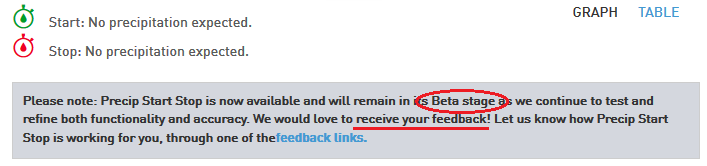
(from http://www.theweathernetwork.com/forecasts/precipitation/canada/ontario/toronto)


The other day I was viewing weather updates on www.theweathernetwork.com when I ran into a new feature "Percip Start Stop" for tracking rain by the hour. What surprised me was not the new feature but the above disclaimer. BETA stage. Soliciting User Feeback.

As a long-time gmail.com user (back when you had to get a invite just to get an account!) I'm used to being the QA department for companies. Google is known for being in "perpetual" BETA, as this Wharton K@W article: "Is Google Stuck in ‘Perpetual Beta’?" outlines. Ever try to figure out the exact "version" of gmail you're using?

However controlled BETAs help facilitate rapid deployment of new features. It's often a low-risk, high gain way of not waiting for a major release to see if there are new features users like and will use. For UXers this is a chance to update small changes without having to wait for major release (but I don't suggest changing the UX too radically too regularly... that's a good way to annoy users). 

"Back in the day" we used to wait patiently for new version, like Windows 3.1, 95, 98, XP, Vista, Windows 7, Windows 8, etc, we expected to have to pay more for the newest release to get new features. Many users didn't upgrade and that's why we now have the Windows XP EOL issue as outlined in this Microsoft support article: "Windows XP support has ended". Yet I think he Web and Mobile revolutions have changed radically for the following reasons:

#1 -  On a website you can generally *only* have access to the latest version. A website generally has usually one version and this makes it easier to maintain. There is no install for a website, so changes are implicit and virtually immediate. When it's it's UP it's OUT! Very different from former native apps which changes only occurred when users installed an update.
(For the record I think Gmail does usually have a linked to revert to the old theme or UI, at least for a little while.)
#2 - Users are always running latest version. Generally speaking users who buy mobile apps from AppStore/Google Play Store have free upgrades and do in fact upgrade often. Pretty much when the new iOS update is out within days everyone is upgrading.
(After Heartbleed Bug and other vulnerabilities it seems like some apps update every few weeks now. I always get these notifications on my iPhone.)
 #3 - Users culturally embrace change. For the most part users are very open to changing UI. Therefore, because there generally isn't a uproar or backlash, this has given license for companies to regularly re-vamp their apps and websites, almost as often then as they re-org.

(UX Warning: However I've encountered issues with older users who spent years learning how to to use Hotmail.com, only to have one day all the button changed on them and not know how to use the site anymore.)
 #4 -Cloud SaaS and pay-per-use. Since companies like SalesForce.com have turned software into a lot like leasing cars. If you don't care to own it then were happy to give you the latest and greatest car every few years (or in internet years, every few months).
 #5 - Rapid pace of change. It's likely cliche, but really the pace of change is so quick that without a steady pace of updates many of our websites and apps would be obsolete. Every so often I read a UX book with a screen capture of a website from 5-10 years ago and laugh how outdated the IxD is.
The only unfortunate part I see in perpetual BETA program is that sometimes I feel companies use this as license to release lesser tested software. In a true BETA I should be providing feedback on my experience, not submitting bug reports. +_+

(In full disclosure, I work for SAP and we have a very strict release process and I don't think it's changing any time soon. For the curious, it's called I2M (Idea-to-Market) and PDF executive summary is available online: Product Quality at SAP.)

However even SAP is quickly becoming a cloud company (see SAP buying SuccessFactors for 3.4 Billion back in Dec 2012). When you move to SaaS/on-line/Cloud offering, you are basically no longer owning the maintenance and upgrade of the platform. So when we upgrade the Cloud, we're doing it for everyone, and this allows us to roll-out these BETAs and hopefully provide things even quicker than ever!

Hope that helps...

Wayne Pau

p.s. For more jokes about Gmail spending so long in BETA you can read this blog: "Gmail leaves beta, launches "Back to Beta" Labs feature" in which Google actually added a way to put back the BETA disclaimer. ;) Jokes.


(from http://gmailblog.blogspot.ca/2009/07/gmail-leaves-beta-launches-back-to-beta.html)

Sadly when I tried it on my gmail today I couldn't find the setting. I guess that joke got old quickly. Likely when they started to charge companies for an "enterprise" version.

It also does not escape me that ironically I'm blogging this on Blogger/Blogspot, which is also another Google product. :)

Monday, 16 September 2013

UX: Silly Error Messages (Is this Violent & Destructive, ending in Utter Failure?)

This is a quick post. Today, as I was doing some UX work, I got this error in Windows 8:


It was while trying to over-write an image (PNG) with a newer one. 

Two quick reactions:


  1. I would hate to be translator @ Microsoft who had to translate this into other languages. How bad is it really? Catastrophic, that must be really really really bad. Better get out my thesaurus so I get the 'tone' just right...
  2. As a end-user, I was trying to understand what to do next? I tried it again, got the same error. Then I was thinking, do I need to restart my laptop? So do I prepare for a upcoming crash? Should sell my stocks and prepare for the end of the world?


This is what Webster's dictionary says about the word:
1 :  the final event of the dramatic action especially of a tragedy
2 :  a momentous tragic event ranging from extreme misfortune to utter overthrow or ruin
3a :  a violent and sudden change in a feature of the earth
3b :  a violent usually destructive natural event (as a supernova)
4 :  utter failure :  fiasco <the party was a catastrophe>
So basically my Folder view is like a:

  1. A tragedy...
  2. A 'violent' and 'destructive' end...
  3. An "Utter" failure...

On top of THAT... my only recourse or option is..

"press OK to continue"

Like everything is going to be OK after this Catastrophic event. 

No 'cancel'. No revert. No retry. No where to get additional help or error codes. No support logs. Nothing... 

...Go about my normal business. Move along. Nothing to see here... 

The 'error message' does not match the 'response'. It doesn't seem like an appropriate response. As an end-user (with my Design Thinking/Empathy hat on...) this would irk me. It's like it got me worked up for nothing!


But at last, thanks Microsoft! You made my day. =) Or at least you put a smile on my face... (To be fair, Microsoft isn't the only software vendor to have error messages like this. We all do it... we should just all do it less often...)

Bottom line: I'm going to think twice when I write my next error massage. That's for sure...


Hope that helps...

Wayne Pau

Tuesday, 3 September 2013

Fun Topic: Microsoft buys Nokia (what's left for RIM?)

(via CNET article)

The news just came out that Microsoft is buying Nokia. Or pretty much all of Nokia. Basically the cellular business and patents, while absorbing 32K employees, about a 1/3 of the current ~100K workforce. This is interesting news as a few weeks ago I was talking about Samsung + Intel's investment in Tizen. It almost seems that to be successful today, you need both write the OS *and* build/sell the hardware, in Apple type of model. RIM and Apple are still the only vendors that exclusively write an OS for their own hardware.

So the articles say that board met over 50 times to discuss the purchase and that it had been in works since Feb 2013 @ MWC. Ironic, because I believe that Microsoft maybe then was trying to lower the cost of buying Nokia, since they marginalized Lumina users by not offering a Windows Phone 8 upgrade. John C Dvorak @ PCMag gave a pretty scathing article that finished with this quote:
"But it is not just as smart. Rolling out Windows Phone 8 and screwing over its only real partner proves that."

Google did purchase Motorola Mobility in August 2012, but said it's intentions weren't to dominate the cellphone market, but rather offer more features faster and cheaper and have more patents to defend itself. This was clearly a campaign to Android ODMs that Google was not abandoning them and that they should keep on pushing Android products. For he most part it has worked because by far the only real Motorola Android device I've seen of significance is the Motorola Xoom which was the first Android Tablet. For me, Android has been mostly a landscape of Samsung and HTC devices, but that may be changed as I discussed here.

Microsoft will likely have to also calm HTC, Samsung and other Windows Phone makers, but I am not sure they will be not so calming as Google. Ina Fried @ All Things Digital wrote this article on the topic.

Many knew something was coming. As I wrote before as reason #4 for creating Tizen, Samsung and HTC are already paying Microsoft for every Android phone they sell, which is big part of the $220 million Microsoft says it's makes in mobile. You can see in my Samsung makes Android, Windows Phone & Bada phones, Windows Phone from IDC only accounts for 2.6% of the 2012Q4 market. Sadly I believe very little of this was from direct Windows Phones licensing.

If Microsoft want to turn things around, they needed to do something, and that's what they did. They bought the biggest Windows Phone ODM and will put their marketing machine behind it. I heard many times that if Windows Phone had Nokia hardware engineering and Microsoft Marketing, it could succeed. We'll see how right (or wrong) they were.

As I said in my 'What happened to Surface RT' article, obvious something went wrong with Microsoft's last foray into mobile hardware. It will be interesting to see what happens now with Nokia. Seems like it's doubling down after Surface RT failed, so we'll see if it's "good money after bad" or it's what saved Microsoft post-Ballmer.

So bottom line, if anyone thought that Microsoft would buy Blackberry, I think they are having second thoughts, as they are about $7 billion poorer and 32K employees larger. With 1/3 more employees (and overhead) and having spent that much capital, Microsoft is really "betting the farm" on mobility. It will need to justify that investment quickly.

Microsoft must see the writing on the wall that you just can't *only* be tops in the desktop/laptop/server O/S and BackOffice/Tools markets. This ZDNet articles says it has some cash-cows, but it must see mobility is where it needs to be 'long term'.

Hope that helps...

Wayne Pau.

p.s. Just random thoughts, but if Samsung is teaming up with Intel with Tizen, Microsoft has purchased Nokia, has already been bought by Google and Apple is doing fine, I'm not sure there are suitors for Blackberry (as a whole). Maybe if an unlikely suitor like Oracle (or even IBM I guess) wants to get into the Mobile market? Dell seems have enough problems and HP/Compaq has had it's own share of issues. Maybe an Asian vendor like HTC, Huawei or ZTE will come up with the cash, as I was surprised when Lenovo purchased the personal computing business from IBM. The only other names out there are really Amazon and Facebook (who already has a pact with HTC, but it's reaper much reward from it...)? It will be interesting... I'll be paying close attention.

Here's Henry Blodgett @ Financial Post's take on the situation. Ironically #5 was bought by #6 on his list. 


Tuesday, 30 July 2013

Fun Topic: What happened to Surface RT? (Is this PlayBook OS all over again?)

$299 Surface Tablet @ Dell


Well if you haven't heard yet, the price of Windows RT tablets are dropping. About a month ago it happened first @ Dell, dropping their XPS 10 to $299. Really they weren't the first, just the most dramatic. 

Ironically, this all reminds of me PlayBook firesale or even the HP TouchPad firesale. When RIM (now Blackberry) did their firesale over a year ago everyone knew it was the end of the line for RIM Tablets. However there were people still clinging to their devices until Blackberry announced finally that BB10 OS would not be coming to Playbook. For this was final nail in the coffin for Playbooks. Blackberry will say it needed to do Playbook to learn to do BB10 properly. Now CEO Thorsten Heins saying that Tablets are dead:


“In five years, I don’t think there’ll be a reason to have a tablet anymore. Maybe a big screen in your workspace, but not a tablet as such.” - Thorsten Heins
(http://www.policymic.com/articles/39021/thorsten-heins-blackberry-ceo-tablets-will-die-in-5-years) 
I'm not entirely sure this isn't at some level sour-grapes as BB clearly failed and has abandoned the Tablet/Phablet market. Even Tim Cook and post Steve Jobs Apple finally gave in and built the iPad Mini. Also don't tell that to Amazon's Kindle department, which sales are on fire (vs. a fire sale).  

I love some of the tongue & cheek articles that joked that Star Trek invented tablets years ago. 4Oh5 clearly shows that even before Picard had on TNG, 2001: Space Odyssey had it too. I wonder if Heins is saying all those sci-fi movies were just plain wrong. Either way, after what Heins said, it's very very unlikely that Blackberry is ever going to make another Tablet anytime soon.

WebOS also went through a file-sale. Originally of Palm origins it was sold to HP. HP built a tablet, the TouchPad using WebOS and eventually had to liquiddate it's stock through a fire sale two years ago that ironically brought down eBay. HP was to offer the WebOS as open-source, but LG seems to have licensed WebOS for TVs, but not phones. 

If you read my post on Tizen, you'll notice that LG is not on the list of vendors, however likely is a company that is paying Microsoft the 'Android' patent. This is the response from CTO Dr. Skott Ahn as why LG didn't just go ahead and put Android in their TVs:


 Asked why it made more sense to invest in webOS than to repurpose Android, Ahn said that LG would use Android "together" with webOS, but that he thinks "webOS is better in some of the user experience, like card UI."
(http://gadgets.ndtv.com/laptops/news/hp-to-offer-webos-as-open-source-software-224848) 
Part of me is wondering if webOS license from HP was cheaper than the Android virtual license to Microsoft.

In the end HP, (unlike Blackberry) is returning back into the Tablet market again, two years after TouchPad fire sale. They are now aiming to sell the Slate, which runs Android even though they own WebOS. Unlike Thorsten, CEO Meg Whitman isn't making any claims that Tablets are passe.

So what's the bottom line? The fire sale could be the end-of-the-line for Surface RT. I'm not entirely sure I would shed a tear. I wasn't very fond of the 'legacy' windows interface that had icons so small I could only use with a touchpad in the keyboard. I thought the UX was a little 'too-flat' and didn't offer users any affordances on which were buttons, etc. I also agreed that there was utter confusion on which apps were running on Surface RT (formerly metro) and which couldn't.

I guess we'll have to wait to see. However I imagine we won't have to wait for long.

Hope that helps...

Wayne Pau.


Monday, 15 July 2013

Fun Topic: Heard of Samsung Wave or Cronus phones? (aka Samsung != Android)


Did you think that Samsung only made Android devices? Turns out Samsung is planning to offer at least the following lines:

  • Galaxy - Very popular Android O/S series (includes S3, S4 and Note 2)
  • ATIV/Cronus - Windows Phone O/S series (Cronus not yet released)
  • Wave - Bada O/S series, Samsung's home-brew O/S
  • ??? - Tizen O/S series (aiming for Q3 2013) 

(Look for a future blog posting on Tizen OS coming soon!)

This is over and on-top of Linux distribution that is already currently in Samsung SmartTVs that also runs apps. I do think there are plans to migrate that over to Bada platform at some point in the future (and LG is already committed to using WebOS in their TVs), but you can see how this is quickly this approach is filling up the Samsung Developer portal:


(http://developer.samsung.com/home.do)

At some point you have to wonder how is Samsung going to even handle the roadmap and competition of resources for all these platforms. Logically I believe that Bada will eventually be rolled into Tizen and SmartTV linux platform phased out. Still, while Samsung appeared to be the champion for Android OS devices, it seems somewhere along the way they got diluted and likely that means they aren't 100% committed to the Google platform long term as everyone once thought.

Contrast this to Apple who has a single unified iOS platform with no fragmentation. They control both the direction of the OS and the production of hardware and therefore can optimize the development of both. The only other vendor with the same strategy is Blackberry (with BB10). 

Let's review the current IDC's current Mobile OS breakdown from Q42012:

By effectively offering multiple OSs, we can add Android's 70.1%, Windows Phone's 2.6% and Linux/Other 3% to give Samsung access to 75.7+% of the market. (I put "+" because both Android and Windows Phone had huge growth between 2011 to 2012, so we expect that trend to at least continue.) Besides BB10 and iOS, they are trying to 'cover all the bases'. Those are some staggering numbers that few other vendors can claim.

If you have the time, a very interesting read is an article by Chris Velazco of Tech Crunch here (however, be warned it's very very long):
How Samsung Got Big - http://techcrunch.com/2013/06/01/how-samsung-got-big/
Basically it tells of how Samsung came into power and shows how Samsung is really the GE of Asia. Tales of corruption and family politics reminds me a lot of Korean Drama 'Live in Paris'. A family run-empire in which chairman Lee Kun-Hee had to be pardoned by a Korean President twice to avoid jail time! The very same chairman that radically changed Samsung from a low-cost, poor quality alternative to industry leader did so with drastic moves, including being quoted as saying:
 "Change everything but your wife and kids..." - Lee Kun-Hee 
and having a bonfire the consumed $50 million of shoddy equipment in one day in 1995 in front of 2000 employees! (I don't even want to *think* of the environmental consequences of something like that...)

Ultimately Samsung's foray into High-end Mobile Handsets is a lot like how they overtook many Chinese and Japanese rivals. Turns out that doing business in Korea is not that different from anywhere Asia. 

Bottom Line: A part of me is still worried that the biggest, baddest champion for Android is really just a 'part-time' champion. So while Samsung is investing and making innovations that help shore-up Google's inherent limitations/weakness in things like security with AES and KNOX, ultimately it seems that Samsung doesn't view Android as "their" own OS (like Bada for instance). Given a couple of years, would Samsung be pushing Windows Phone or Tizen over Android if the market seemed to be swaying that direction? Letting HTC, Huawei, ZTE, LG and others fend for their own (excluding Motorola who is owned by Google)?

Comments? Thoughts? Concerns?

Hope that helps...

Wayne Pau.

p.s. if you're looking for more Korean Movies/Dramas, might I suggest My Sassy Girl and it's prequel Windstruck. It's one of my wife and I favorite movies. 


(If you have found this post helpful, please consider either following this blog directly, following my twitter account @Wayne_Pau or request to add me on LinkedIn. If you've found this topic or another useful, I'd also greatly appreciate if you would be willing to spread the word on this blog by sharing it with your friends...Thanks!)


Thursday, 6 June 2013

UX Term of the Day: "Fitt's Law" (aka Fat Fingers...)


Ever have one of those controls on a screen that was Soooooooo small you couldn't tap it twice in a row if your life depended on it? These are the apps that make me pull out my pinky-finger in order to try to tap something... (If I'm totally honest with myself, pretty much every mobile phone soft-keyboard feels like this at times...there just *never* seems to be enough space to fit in all those keys!)

Earlier this year I was helping test an application for BB10 that clearly had some usability struggles. One of the issues that really stuck out was that one UI controls was about 4mm in width. That's actually about 1/2 what size it should have been.

So how big is big and how big is big enough? Turns it's not arbitrary and we have some math & science that basically tells how big something should be. The formula often used is called Fitts' Law:


Fitts' Law Formula

I've *simplified* here, but Difficulty (or technically the ID - Index of Difficulty) is logarithmically proportional to Distance Moved or how far the user has to move (the cursor or their "finger") and the Width of Button or the size of the 'tappable area' of the UI control. 

When we're talking about menu or nav buttons which could be selected from anywhere, really we don't care about distance moved (because it varies a lot), so really usability is somewhat *inversely* proportional to size. Even more so, if size *approaches* zero, the difficulty level becomes infinite! (Starting to remember infinity and limits from first year calc class, right?) 

In plain English, smaller buttons are harder and larger buttons are easier. Obvious right?

*However* the 'amount' that they are easier to use isn't linear, but rather at some point making the button bigger doesn't help *that* much. The converse is also true, at some point a little smaller can make it *really* *really* *really* hard to use.

For the full math and derivation of Fitts' Law, I'd suggestion the following links. (These are mostly best left for "geeky" HCI PhD's...)


For the rest of us 'mere mortals', I would use Microsoft's (see below) much more human-understandable guidelines. I especially like MS depiction of various 'sizes' of fingers!

Quote from Microsoft (Win8) Touch Interaction Design Guide:


"People often blame themselves for having "fat fingers." But even baby fingers are wider than most touch targets. The image on the left shows the width of the average adult finger is about 11 millimeters (mm) wide, while a baby's is 8 mm, and some basketball players have fingers wider than 19 mm!"


http://msdn.microsoft.com/en-us/library/windows/apps/hh465415.aspx

MS goes on to say if you have a control @ 7mm, your error rate for mis-taps is about 1%. If you can make it at least 9mm, it's 0.5%. Notice how the curve is *almost* logarithmic? (Anything after 10-11mm, the difference is marginal at best. The % of missed taps gets smaller, but never 'actually' becomes zero...)

http://msdn.microsoft.com/en-us/library/windows/apps/hh465415.aspx

Apple too states that UI controls should be about 44 Pixels, which is about 9mm in real life on iPhones and iPads. Google/Android says 48 DPs, which is about 9mm on Superphones and Tablets, but the guidelines say stay within 7-10mm range if possible. 

(I think this is one of the *only* times I've ever seen all 3x big players agreed on anything!)

So bottom, if you don't want to do the messy math, 8-10mm should be a good threshold. Any smaller and you run a real risk of "mis-taps" from your mobile device (and likely *frustrated*) users.

Hope that helps...

w.

p.s. Still don't believe me? Every platform has a default "calculator" app. Load up the calculator app on your device and measure the physical size of the buttons. Break out the ruler and give it a try yourself!

Every time I've done this, at least one dimension is always at least 8mm long or longer. 


For the record here a quick snapshot of my finger on a ruler. I'd say that's just under 10mm and I assure you I don't have basketball player sized hands!