Thursday, 17 October 2013

Design Thinking: Creative Confidence

I haven't really talked about DT in a bit, so when read about David and Tom Kelley's new book "Creative Confidence: Unleashing the Creative Potential in All of Us", it really got me thinking. 

(Cover from Amazon here)

For those who have been around Design Thinking for a while, David Kelley is pretty much the 'Michael Jordan' of Design Thinking (and his brother Tom is at least his 'Scottie Pippen' or even more). Being the founder of IDEO and Stanford d.School he is at the forefront of everything DT related. However even more amazing is that his brother, Tom Kelley is also a great force at IDEO and the author of two fundamental books on Design Thinking in The Art of Innovation and The Ten Faces of Innovation

(David Kelly - from Stanford d.School website)
However if you listen to David Kelly talk, it shouldn't shock you. He talks about his dad and how he encouraged their family to actually figure out how things worked and actually fix things. He talks about how he works on projects with his daughter even now. 

I haven't read the book yet, but I assume it's likely along the lines of very powerful TED talk he gave in May 2012 on Creative Confidence:


I really encourage you if you haven't heard this powerful talk, to go head and spend the 11 minutes it takes to view it. I have a feeling that for many it will touch you. It doesn't matter if you're a developer or designer. I feel if you're teacher, you should be made to watch it!

In the talk, David talks about CEO types saying they are "Not the Creative Type". He places this as a "Fear of Judgement" many adults have developed. He tells us that with things like Design Thinking, if you "stick" to the process, you can learn to be creative. (My own Design Thinking coach Niels Billou always says "You got to be believe in system...believe in the process...") He states that after his cancer, his new mission is help people "regain their creative confidence". 

Here's an article from Harvard Business Review from David & Tom about Creative Confidence as well. It's a lot like the TED talk, but with some more concrete d.School examples (Pulse reader, Baby incubator, etc):
If you look at David Kelley 60 minutes interview, around 6:40, they talk about his childhood, where "...he learned the value of building with his hands...".  A great story is how he took apart the family piano, but neglected to put it back (because that was less fun).
While I don't want to go on the record as encouraging "failure", Niels would always tell me that over 80% of projects fail. A lot of people don't like to hear that. What if David's mom got upset that not every project of David or Tom's went right or got finished? What if David or Tom's crazy ideas were ridiculed, put down or discouraged? Design Thinking has always been about "Fail often to succeed sooner". It's *never* about never being able to or fear of failing

A great by-product of this interview is that David talks a little about his relationship with Steve Jobs and it humanized him a lot for me. What struck me is that David says that Steve tells him the important things in his life, his kids and focusing on the family. Kids. Not legacy, not devices, not apps.

That got me *thinking*. 

If we as Design Thinkers want to change the world, maybe we don't need to do it with 30 & 40 years olds, but maybe with 3 & 4 year-olds. For me, the lesson is that with my 2x daughters that I can help them best by making sure their 'Creative Confidence' is nurtured, blossoms and never questioned.

OH yeah. Here is blog from Metropolis that I believe has some excerpts from the new book and triggered this blog post in the first place!

Hope that helps...

Wayne Pau

p.s. Yes, if you watch the 60 mins video, it's the same SAP founder Hasso Plattner that helped David Kelley the d.School, to the tune of $35 million. I can also attest that yes, SAP is still very much committed to Design Thinking. Hasso also went on to found HPI School of Design Thinking back in Germany. He and SAP do walk-the-walk.

Wednesday, 16 October 2013

Fun Topic: Cellphone Economics Part 3 (No Free phones...)

Sorry for lull in posting. It's been a busy few weeks...

(iPhone 5C from here)


Well I guess I was wrong about the iPhone 5c. Turns out the "c" didn't stand for cheap. At $450 it isn't really that much cheaper that it would be a zero dollar phone on 2 year a contract. (Update: confirmed. See here that it's $99 phone on 2 year from Verizon) I don't see that many new people who weren't already planning on buying a iPhone to go ahead and buy the iPhone 5c.

(Turns out the out-of-pocket difference is only $100 on 2 year contract between iPhone 5c and 5s. For my $ I would have likely upgraded to 5s.)

No "Free" Amazon Phone.

Also it seems that Amazon rumours of a FREE Android phone have been over exaggerated. From the looks of it, it will be "likely" an "at cost" phone, just the Kindle Fire, if it ever launches. If the Kindle Fire HD is around $215, how much would you pay for an Amazon phone? More or less than the 7" tablet? If you cut costs from smaller display and battery, will that offset the cellular modem costs?

My thoughts were the Kindle sold right against the Kobo and Sony reader. 7" is basically the size of a trade paperback and just smaller than a hardcover. Would you attempt to read a whole novel on your phone?
Part of me thinks that people already read *a lot* of email on your phone. Add on top of that, today on my commute I forgot my book, you *always* have your phone on you. This means your more likely to read more, even if it's in shorter bursts.

As a side note, great article on why the Kindle Paperwhite outsold the Sony Librie:

The other part of me feels that the main motivation of a cell phone is being a phone. If the Amazon phone isn't a better phone (or at least a very very good one), why would you sacrifice that to get books which you can already get via Kindle app? Building a WiFi 'tablet' I think is easier than true telephony features. Most phones today have a lot of software and hardware to make calls sound good.

Watch out for Xiaomi?

Yes, it's *that* company that lured a Google Exec away with a $58 million compensation package.
(New Xiaomi Mi3 from here)


From the reports (Xiaomi does *not* sell here in North America yet so I have never played with one) Xiaom Mi is the new 'king of cheap'. In Asian, this phone outsells the iPhone by a huge margin. I think the market in North America is huge for zero dollar phone on contract and maybe this is it.

You believe it? Here is an article showing just how fast these phones are selling:


From my Asian friends, they said they have heard nothing by positive things about it in the news & social media sits overseas.


Asus (Cheap) phones also coming soon?

With the success of Nexus 7 by ASUS, it seems they are ready to enter the phone market in North America. This is possibly via FonePad. Or maybe a totally new device. So far they have been locked out of the market, but with their engineering skills and co-innovation with Google, I see a very good chance of them being successful. If they can get out a Market-Leading 7" tablet for $250, how hard would it be for them to release a 4-5" good phone for under $300?

The bottom line is that I strongly feel like we need better cheap phones to continue driving cellular data and next wave of apps. The feature or dummy phones available today are getting long in the tooth. While they won't make a killing on margin per device, I see whoever can do this win on total sales and revenue. I think too many people are overdue for an update on a lower cost phone and the window of opportunity for major mobile device penetration in North America is now. (Implying the market for $700 and $800 upgrades of bleeding edge devices is drying up for now.)

Overseas where devices aren't usually subsidized as heavily, only the big spenders it seems can purchase devices outright at the high end of prices. Buying a new iPhone every year can add up quickly. Damage, loss or theft of a expensive new can be painful.

Lastly, not every wants or needs a Porsche. Companies like Hyundai are making a very good living selling reasonably priced cars.


So with that, are you, or someone you know looking for a new phone? Thoughts on what you might get?
Hope that helps...

Wayne Pau

p.s. While the talk now is about BYOD, there are stilll companies that give employees company standard issues phone. While a price difference one time of $50 to $100 might not seem like a lot, what if you multiply that out by 500x or more employees every few years? (FYI - that's $25K or $50K a year. Or $250K to $500K for 5000x person company.) I don't imagine that the more expensive product increases productivity that much (or if any at all).

Monday, 16 September 2013

UX: Silly Error Messages (Is this Violent & Destructive, ending in Utter Failure?)

This is a quick post. Today, as I was doing some UX work, I got this error in Windows 8:


It was while trying to over-write an image (PNG) with a newer one. 

Two quick reactions:


  1. I would hate to be translator @ Microsoft who had to translate this into other languages. How bad is it really? Catastrophic, that must be really really really bad. Better get out my thesaurus so I get the 'tone' just right...
  2. As a end-user, I was trying to understand what to do next? I tried it again, got the same error. Then I was thinking, do I need to restart my laptop? So do I prepare for a upcoming crash? Should sell my stocks and prepare for the end of the world?


This is what Webster's dictionary says about the word:
1 :  the final event of the dramatic action especially of a tragedy
2 :  a momentous tragic event ranging from extreme misfortune to utter overthrow or ruin
3a :  a violent and sudden change in a feature of the earth
3b :  a violent usually destructive natural event (as a supernova)
4 :  utter failure :  fiasco <the party was a catastrophe>
So basically my Folder view is like a:

  1. A tragedy...
  2. A 'violent' and 'destructive' end...
  3. An "Utter" failure...

On top of THAT... my only recourse or option is..

"press OK to continue"

Like everything is going to be OK after this Catastrophic event. 

No 'cancel'. No revert. No retry. No where to get additional help or error codes. No support logs. Nothing... 

...Go about my normal business. Move along. Nothing to see here... 

The 'error message' does not match the 'response'. It doesn't seem like an appropriate response. As an end-user (with my Design Thinking/Empathy hat on...) this would irk me. It's like it got me worked up for nothing!


But at last, thanks Microsoft! You made my day. =) Or at least you put a smile on my face... (To be fair, Microsoft isn't the only software vendor to have error messages like this. We all do it... we should just all do it less often...)

Bottom line: I'm going to think twice when I write my next error massage. That's for sure...


Hope that helps...

Wayne Pau

Tuesday, 10 September 2013

Fun Topic: Cellphone Economics Part 2 (aka. WiFi iPad vs. 4G iPad)

So this is a follow-up to Part 1 in which I compared the iPhone 5 to iPod Touch, which was almost 1/2 the price. I got thinking and said, 'hey wait, the iPad comes in in WiFi and WiFi+4G versions', maybe we have a breakdown for that. Luckily, IHS/iSuppli has come through again:


(From http://www.isuppli.com/Teardowns/News/Pages/New-iPad-32-GB-4G-Carries-364-35-Bill-of-Materials.aspx)

So, when looking at the iPad 3, the main difference is the $41.50 modem. (I believe this is a Qualcomm Golbi, but it's not officially called out. For some reason it's about $3 more expensive than the one in the WiFi iPod Touch.) We also have a slightly more expensive Manufacturing cost, about $0.75, most likely from the need to mount and solder on the chip, maybe antenna, etc. The total difference is $42.25.

The simply math is that $42.25 allows Apple to charge $130 more. That's basically 3x or 308% markup. Compare that to the roughly $52 (Camera + 4G modem) that allows Apple to charge $420, that 8x or 807% mark-up when going from iPod Touch 5 to iPhone 5!. (This is one is "approximate" because I have costed it out totally electro-mechanical differences + labour cost, etc., unlike in the iPad 3). 

Clearly, there is a huge mark-up for making an iPod Touch 5 (entertainment device) into a iPhone 5 (cell phone). 

If you think this is the only place where Apple really gauges people, it's not. Another very obvious area is extra memory aka. NAND flash memory. (BTW, note that Apple isn't the only one to do this.)  For iPad 3 WiFi+4G, going from 16GB to 32GB, it's an additional $16.80, but an overall consume cost of $100, or basically 6x or 595% mark-up. Going from 16GB to 64GB it's an additional $50.40, but an overall consume cost of $200, or basically 4or 397% mark-up. (Note to self, if you're splurging, it's a better deal to go for the larger 64GB. You're paying less mark-up!)

I *think* this is a BIG reason why all iOS devices don't offer external storage via MicroSD slot is because it makes good business sense *not to*. The going rate today I think is about $50 for 64GB MicroSD. So on any Android with MicroSD slot you are only paying like 25% of the price (or $50 instead of $200) to get at least 64GB of (extra) memory (that you can re-use potentially later down the road). 

Andrew Rassweiler of IHS pretty much sums it up here:
“The NAND flash memory is one of the key profit-generating components for Apple in the new iPad line, as it has been in previous iPads and in the iPhone family,” Rassweiler noted. “Apple makes far and away more money in selling consumers NAND flash than NAND flash manufacturers make selling it to Apple. And the more flash in the iPad, the higher the profit margin there is for Apple.”
(http://www.isuppli.com/Teardowns/News/Pages/New-iPad-32-GB-4G-Carries-364-35-Bill-of-Materials.aspx)
So while there may be concerns with security of having external storage, etc, Apple is definitely taking full advantage of the situation.

Hope that helps...

Wayne Pau.

p.s. So what *if* Apple did offer external storage like Android does? 

Once again with Android  (And from this post, it seems *a lot* actually do, if it supports SDXC, you could actually get even more memory than just 64MB. The specs say that SXDC can actually hold up to 2TB! Imagine a 2TB iPhone? No need for iPod Classic anymore...

However SD card storage comes at a cost. It's harder to manage from a software point of view and it's a potential security threat or attach point. Yet a big part of the real motivation for for Apple is 'possibly' economics.

For the record, HTC One line (everywhere but Asian) doesn't offer SD Card storage either. So it's not just Apple

Monday, 9 September 2013

Fun Topic: Cellphone Economics Part 1 (aka. iPhone vs. iPod pricing)

The question I've been asking myself lately is:


"Are cellphone prices heavily inflated?"

So a few weeks ago I had a posting about the rumoured iPhone 5C release and I had a link to IHS/iSuppli breakdown of the iPad Mini. That got me thinking (which is never a good thing...) as I was peeking around at the pricing of the latest generation of iPod Touches and compared that to iPhone 5.

  • iPod 5 Touch 16 GB - $229
  • iPhone 5 16 GB - $669 (unlocked)
Pricing from Apple.com

 I was *shocked* (although I probably shouldn't have been) that you could get a iPod Touch 5, essentially get a iPhone 5 without the cellular part for less than HALF the price!

What is the *same*:


  • 4" retina display (1136x640 @ 326 PPI)
  • Almost identical bodies (iPhone is 7.6mm vs iPod 6.1mm)
  • FaceTime HD Camera (720p)
  • WiFi & BT connectivity
  • Apple EarPod headphones
What is *different*:
  • iPhone 5 has 8MP camera, iPod 5 has no camera (only 5MP on 32 + 64MB models)
  • Qualcomm Golbi MDM9615 4G LTE modem
I checked to see if IHS/iSuppli had a breakdown of the iPod 5 available for public consumption, but they did not. However I did find the iPhone 5, which I was at least a starting point to do some estimates on:

(From http://www.isuppli.com/Teardowns/News/Pages/iPhone5-Carries-$199-BOM-Virtual-Teardown-Reveals.aspx)

So... basically the total cost of iPhone is $199 in parts and $207 in BOM + Manufacturing in 2012. That's about 29.6% of $699 list price. Now if we subtract out the Golbi modem and camera, that's a simplistic subtraction of $52. That leaves $155, or 67.7% of the list price of $229. (Note: I image if I were cut everything we'd be closer to 50% mark... with lesser processor, etc)

That's *shocking*, that the margin on iPod is HALF of what it is on the iPhone.If we interpolated the same mark-up on iPod as the iPhone, we get $306, which is less than HALF again what the list price is. Now there may be more sub-par components in the iPod that I haven't caught cost-wise, but I can't image that you could get the BOM + Manufacturing costs below or around $100

(I'm actually more confident in that, after looking at the iPod Nano breakdown, which  IHS/iSuppli pegged at $43.73. This is with only 8MB and tiny display. There is $40 difference alone in LCD display and $6.45 in memory. That would put that almost at $90.20, and we aren't adding in more costs for bigger battery, WiFi and housing ,etc.)


What are looking at here then? I mean the iPod Touch is the closest thing to a cellphone without a cellular modem. Does this mean that Cellphone Companies and the ODMs are colluding together and inflating the prices of "smart-phones"?


This article from CNET had Luke Westaway discuss a very similar comparison with Asus. However I found the article somewhat unsatisfying considering I have the BOM breakdown in front of me from iPhone 5. Processor only accounts for less than 10% of the build cost.

Bottom line is that cellphones have a inherent "luxury" tax over non-cellular versions. This is probably driven by carriers who want very expensive phones that they can heavily subsidize with multi-year plans.  They want to sell you $700-$900 phones, it makes good business for them. 

Note (again): please understand that I am using information from IHS/iSuppli in my analyst which is by no means official pricing from Apple (as I doubt any exists). I have also made a lot of estimates and assumptions. This article was created for education or entertainment reasons *only*. 

Hope that helps...


Wayne Pau.


p.s. So what does that mean for someone frugal like me who might want a iOS device? (ie. for those Candy Crush Saga addicts...not me...personally, I'm OK with my current phone...) I'm wondering if you're better off with a $0 Android phone that you can share WiFi and buy a iPod 5 Touch. The main drawbacks are:

  • you won't have integrated calling and contact book 
  • you will have to carry 2x devices
  • you have to charge 2x devices

but you could be saving yourself like $400! Like you'd also save yourself some data charges as you're more likely to go free WiFi spots than tether to your Android Phone when given the chance @ Starbucks, etc.


I wonder what the carriers would do if everyone did this? Would that deflate or inflate usage charges as maybe more expensive handsets help off-set data, messanging and voice changes?

Tuesday, 3 September 2013

Fun Topic: Hello Android Kit-Kat 4.4 (aka. Goodbye Key Lime Pie)

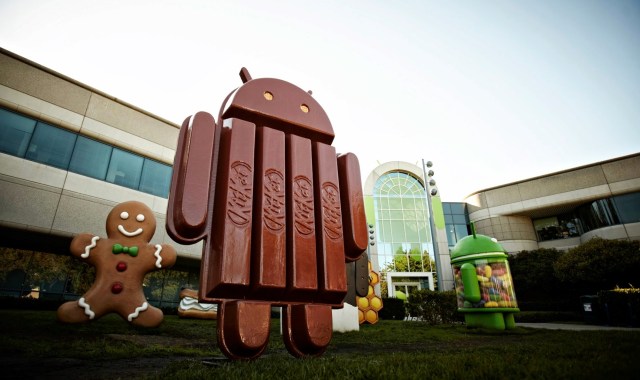
(Photo via TechCrunch)


Ok, so if you haven't heard already, Android 4.4 won't be called Key Lime Pie after all. Ironic because often Google isn't good at keeping it's name a secret and *everyone* I knew thought it was going to be Key Lime Pie. The photo via TechCrunch is Google lawn sculptures, which each represents a different Android version. It goes all the way back to original Android and first "dessert/junk-food" name in Cupcake (after that Donut, E-Clair, Froyo, Gingerbread, Honeycomb, Ice-cream Sandwich and Jellybean).You can read about it on the Android Blog here. (Yes, Android with "A", but there is no "B". Cupcake was the next real release...)

Until now, I only heard a really good story that ICS was in-fact "what do you get when you mix Gingerbread and Honeycomb?" However, KitKat "takes-the-cake" as it's an actual license deal with a trade-mark with Nestle. What is even tastier is that this statue actually represents real KitKat bars that Nestle will produce in the near future (50 million branded packs and a smaller number of actual Android KitKat bars according to the press release).


Nestle Press Release

Talk about very cool promotion! If you want to know more, Google & Nestle have created a site to promote the new Android 4.4 O/S here:


Another really cool idea is that no money changed hands during this promotion. It's basically a "like-for-like" deal, so basically win-win for both Google and Nestle
We’ve reached out to Google for more information on exactly what the deal is here and it confirmed that no money changed hands between the two companies. This is apparently a like-for-like cross-promotion deal.
Bartering is one of the oldest forms of payment and often the most economical. Not sure when the last time I saw two super-brands come together like this and no money changed hands. Is this the first of new "super-deals", which are much like comic-book cross-overs which two brands come together for short-run promo or gimmick? 

A year ago could this have been Android 4.3 Jello-O, and we've seen Bill Cosby sporting the latest Android device? Eventually could there be Android 10 Twinkie

Bottom line, I wonder if in the future O/S versions may be up for naming rights like football stadiums? Or at least up for some co-marketing, cross product campaign. Would Apple even name the new Mac O/S after another product line?

We live in interesting times.

Hope that helps...

Wayne Pau.

p.s. Talking about Twinkies, turns out someone has a 36 year old Twinkie


Maybe because it's out of it's wrapper, but it's not as it was portrayed on Wall-e. The article states that it had the texture of Styrofoam and Hostess representative "who strenuously suggested that nobody eat the thing". However the *most* disturbing things was apparently there was mold on it, and eventually even the mold died off. 
It would be a mistake to say this Twinkie looks none the worse for wear. It reportedly has the consistency of Styrofoam, not to mention having acquired a fine coating of dust during its decades on top of the intercom. It even grew mold at one point, despite all the preservatives, although that’s long dead now.
Not sure I'll ever look @ Twinkie the same ever again. 

Fun Topic: Microsoft buys Nokia (what's left for RIM?)

(via CNET article)

The news just came out that Microsoft is buying Nokia. Or pretty much all of Nokia. Basically the cellular business and patents, while absorbing 32K employees, about a 1/3 of the current ~100K workforce. This is interesting news as a few weeks ago I was talking about Samsung + Intel's investment in Tizen. It almost seems that to be successful today, you need both write the OS *and* build/sell the hardware, in Apple type of model. RIM and Apple are still the only vendors that exclusively write an OS for their own hardware.

So the articles say that board met over 50 times to discuss the purchase and that it had been in works since Feb 2013 @ MWC. Ironic, because I believe that Microsoft maybe then was trying to lower the cost of buying Nokia, since they marginalized Lumina users by not offering a Windows Phone 8 upgrade. John C Dvorak @ PCMag gave a pretty scathing article that finished with this quote:
"But it is not just as smart. Rolling out Windows Phone 8 and screwing over its only real partner proves that."

Google did purchase Motorola Mobility in August 2012, but said it's intentions weren't to dominate the cellphone market, but rather offer more features faster and cheaper and have more patents to defend itself. This was clearly a campaign to Android ODMs that Google was not abandoning them and that they should keep on pushing Android products. For he most part it has worked because by far the only real Motorola Android device I've seen of significance is the Motorola Xoom which was the first Android Tablet. For me, Android has been mostly a landscape of Samsung and HTC devices, but that may be changed as I discussed here.

Microsoft will likely have to also calm HTC, Samsung and other Windows Phone makers, but I am not sure they will be not so calming as Google. Ina Fried @ All Things Digital wrote this article on the topic.

Many knew something was coming. As I wrote before as reason #4 for creating Tizen, Samsung and HTC are already paying Microsoft for every Android phone they sell, which is big part of the $220 million Microsoft says it's makes in mobile. You can see in my Samsung makes Android, Windows Phone & Bada phones, Windows Phone from IDC only accounts for 2.6% of the 2012Q4 market. Sadly I believe very little of this was from direct Windows Phones licensing.

If Microsoft want to turn things around, they needed to do something, and that's what they did. They bought the biggest Windows Phone ODM and will put their marketing machine behind it. I heard many times that if Windows Phone had Nokia hardware engineering and Microsoft Marketing, it could succeed. We'll see how right (or wrong) they were.

As I said in my 'What happened to Surface RT' article, obvious something went wrong with Microsoft's last foray into mobile hardware. It will be interesting to see what happens now with Nokia. Seems like it's doubling down after Surface RT failed, so we'll see if it's "good money after bad" or it's what saved Microsoft post-Ballmer.

So bottom line, if anyone thought that Microsoft would buy Blackberry, I think they are having second thoughts, as they are about $7 billion poorer and 32K employees larger. With 1/3 more employees (and overhead) and having spent that much capital, Microsoft is really "betting the farm" on mobility. It will need to justify that investment quickly.

Microsoft must see the writing on the wall that you just can't *only* be tops in the desktop/laptop/server O/S and BackOffice/Tools markets. This ZDNet articles says it has some cash-cows, but it must see mobility is where it needs to be 'long term'.

Hope that helps...

Wayne Pau.

p.s. Just random thoughts, but if Samsung is teaming up with Intel with TizenMicrosoft has purchased Nokia, has already been bought by Google and Apple is doing fine, I'm not sure there are suitors for Blackberry (as a whole). Maybe if an unlikely suitor like Oracle (or even IBM I guess) wants to get into the Mobile market? Dell seems have enough problems and HP/Compaq has had it's own share of issues. Maybe an Asian vendor like HTC, Huawei or ZTE will come up with the cash, as I was surprised when Lenovo purchased the personal computing business from IBM. The only other names out there are really Amazon and Facebook (who already has a pact with HTC, but it's reaper much reward from it...)? It will be interesting... I'll be paying close attention.

Here's Henry Blodgett @ Financial Post's take on the situation. Ironically #5 was bought by #6 on his list.